𝐌𝐢𝐠𝐨𝐫𝐢 𝐓𝐓𝐂 𝐕𝐞𝐧𝐭𝐮𝐫𝐞𝐬 𝐢𝐧𝐭𝐨 𝐏𝐨𝐮𝐥𝐭𝐫𝐲 𝐅𝐚𝐫𝐦𝐢𝐧𝐠 𝐭𝐨 𝐁𝐫𝐨𝐚𝐝𝐞𝐧 𝐈𝐧𝐜𝐨𝐦𝐞 𝐒𝐨𝐮𝐫𝐜𝐞𝐬
As the government struggles to provide capitation to various learning institutions, some have devised alternative mechanisms to raise extra income, enabling them to stop total dependency on students’ fees and government support.
A number of these learning centres, in collaboration with various departments in county and national governments, have embraced agribusiness to supplement the government’s capitation and students’ fees.
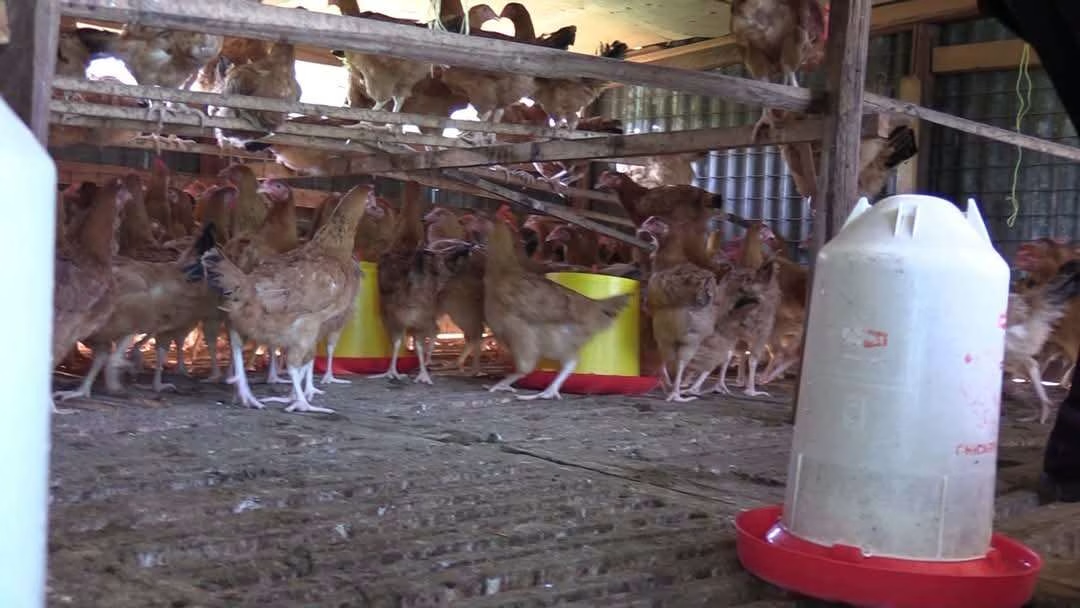
Migori Teachers Training College (TTC), located in the heart of Migori Town, is one such institution that has embraced poultry farming to generate top-up income to sustain the institution, over and above the two traditional sources of income for learning institutions.



The poultry venture, which started in 2020 as a trial introduced as a learning tool for students, has grown over the years. The venture started with 100 birds in 2020. However, in 2021 and 2022 there was a challenge and it was dropped. It resumed in 2023 with 50 birds, 2024 another 50 were added then this year, the institution has added 1,000 birds.
The venture ensures a continuous availability of eggs for consumption and extra income from sale of surplus eggs.
In 2024, President William Ruto urged learning institutions to formulate innovative ways of generating income to supplement what the government was providing, as well as instill training, research and development skills for students and surrounding communities.
According to the Migori TTC Deputy Principal, Naftali Nyang’iti, the poultry venture is meant to provide a balanced diet for its students and generate income to supplement the fees paid by the students.
“We were using a lot of money to purchase eggs for our students, but since the introduction of the poultry farming, we have cut the costs and utilised the cash to manage other developmental agendas,” said Nyang’iti.
The official says that depending on fee payment alone was no longer sustainable, and it was equally important to relook at what the institution can do to provide for additional funds for self-reliance and sustainability.
The institution is also exploring other avenues to ensure diversity as it prepares to partner with Rongo University in terms of academics.
He explains that the project is a precursor to the university courses that the school plans to provide beginning this May, in collaboration with Rongo University.
Nyang’iti also confirmed that the Department of Livestock and Veterinary Services has been helping the institution with extension personnel and skills for running the poultry venture.
He, however, cited various challenges that include a lack of enough space for expansion of the project, a high fatality rate (diseases) and expensive poultry feeds.
The venture has also enabled the institution to make agriculture a compulsory subject, making it comply with the Competency-Based Curriculum (CBC).
“We are training teachers who will soon be employed by the Teachers’ Service Commission to teach primary and junior secondary school learners.
The institution wants to equip our students with practical skills subjects such as agriculture to enable them competently tackle CBC and make it a successful education system,” said Nyang’iti.
Migori Country Director for Livestock, Charles Nyaanga, says that the poultry business is one of the agribusiness models that many institutions have embraced to generate income.
The business model will also give opportunities to students to embrace business ideas as well as give an upper edge for the students who will become teachers after college, he adds.
Nyaanga acknowledges that through a private-public partnership, the county has been assisting institutions like Rongo University and various Technical Training Institutions (TTIs) to set up business ideas including dairy farming, poultry, beekeeping, and vegetable growing meant to propel income generation as well as act as business learning centres.
“The PPP spirit has enabled the county learning institutions to unlock the tremendous potential that exists in the assets the institution possesses,” he said when KNA sought his comment.
“We will continue to offer technical support and skills through the deployment of our extension personnel to generate ideas and give skills to institutions to boost the practical skills of students as well as generate wealth,” the official concluded.
According to Martha Adul, a veterinary officer, poultry farming is one of the easiest ventures for institutions to embrace if the right poultry procedures are followed.
Adul, however, says that farmers should be able to know when to vaccinate the birds to reduce the poultry mortality rate in poultry farming.
On the issue of biosecurity, Adul points out that human interaction should be minimized and only those authorized should access the poultry farm after proper sterilization procedures.
The official admits that disease prevention and biosecurity are some of the issues that many poultry farmers fail to adhere to, leading to the losses and collapse of the venture.
“When a farmer goes to the agrovert to procure a vaccine, they do not know what they are vaccinating against, leading to wrong disease control that results in a high fatality rate,” said Adul.