360,000 Teachers Can’t Access SHA Services- TSC
The healthcare access crisis impacting over 360,000 teachers and their dependents under the Teachers Service Commission (TSC) medical scheme persists, as the Social Health Authority (SHA) refused to incorporate them due to insufficient capacity and significant cost implications.
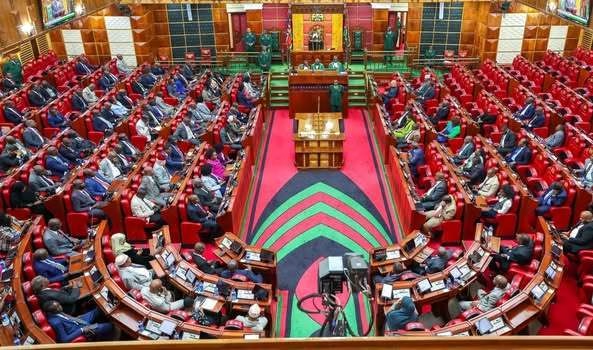
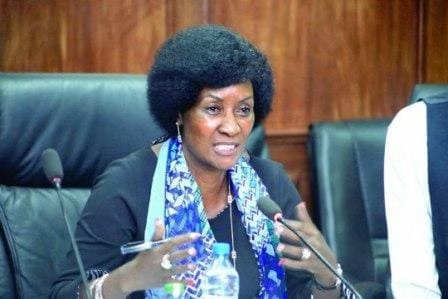
During a presentation to the National Assembly’s Education Committee, TSC Chief Executive Officer Nancy Macharia disclosed that despite the government’s allocation of Sh20 billion for the teachers’ medical coverage, SHA conveyed that it would need Sh37 billion to accommodate the beneficiaries.
“This funding shortfall also impacted the previous National Health Insurance Fund (NHIF), prompting us to extend our agreement with Minet Insurance,” Macharia mentioned.

The Commission entered a three-year agreement with Minet, which is effective from December 1, 2022, until November 2025.
“Last year, when we faced issues with Minet, our plan was to transition our teachers to SHA. We’ve consistently desired for our teachers to gain from the national insurer, even during the NHIF period,” she continued.
“However, SHA informed us that they lacked the required infrastructure and needed Sh37 billion to take over the scheme, which we are currently operating on Sh20 billion. That’s where we encountered a barrier. ”
The Minet-managed scheme has received intense criticism from lawmakers, who labeled it a “mongrel system” that fails to provide timely and efficient healthcare services to teachers and their families.
Igembe North MP Julius Taitum questioned the reliability of the tendering process, implying that the absence of competing bidders may be a tactic to sustain a monopoly.
“You stated that no other insurance companies submitted bids during tendering. Is this because the current managers are mishandling the scheme to deter competition? Are they sabotaging the process to stay unchallenged? ” he inquired.
Teso South MP Mary Emase delivered an emotional appeal, sharing real-life instances of teachers encountering long delays or outright denial of care due to sluggish approvals.
“I know of a teacher whose approval from Minet was postponed until we had to step in through agents. In Bungoma, teachers are left waiting for hours in hospital lobbies. Some are even accused of feigning illness just to receive care,” Emase expressed.
Committee Chair Julius Melly resonated with the frustrations, labeling the medical scheme as dysfunctional and structurally deficient. He referenced a case where a teacher was confined in a hospital for three months due to delayed payments, with Minet only settling the bill after continued pressure.
“We’ve experienced situations where teachers are held in hospitals for months because the school isn’t recognized as a service provider. That’s unacceptable,” Melly stated.
He urged the TSC to relinquish the existing consortium-based model and investigate decentralized, competitive alternatives.
“You should split teachers among several reputable insurers. What you currently have is a directionless system; it’s disorganized and ineffective,” he asserted.
Luanda MP Dick Maungu criticized the centralized approval model, attributing it to ongoing delays. He suggested a cluster-based strategy to enhance service delivery and lessen the burden on central administrators.
“With Bliss Healthcare managing approvals for all educators, it’s not surprising that delays are common. Why not divide them into smaller, more manageable groups? ” Maungu suggested.
Baringo North MP John Makilap cautioned that unless substantial changes are implemented before the contract concludes in November 2025, educators will persist in facing hardships under the present arrangement.
“This initiative is unclear and inadequately organized. If we don’t reorganize it either by splitting teachers into cohorts or transitioning them to SHA, it will continue to let them down,” he remarked.
Taitum urged for a comprehensive investigation into the consortium’s operations, claiming that it was working against teachers’ interests.
“This arrangement is denying fairness to our educators. It’s a coalition of insurers acting in unison, and we require a full-day session to question them and uncover a way forward,” he asserted.
However, TSC Director of Legal Services Cavin Anyour defended the current model, asserting that it reflects the best option available in the private sector.
“At the time of bidding, Minet partnered with a consortium of eight leading medical insurers. They are the country’s foremost providers, and each fulfills a particular role. They absorbed all capable firms, excluding the smaller entities that lacked sufficient capacity,” Anyour clarified.