
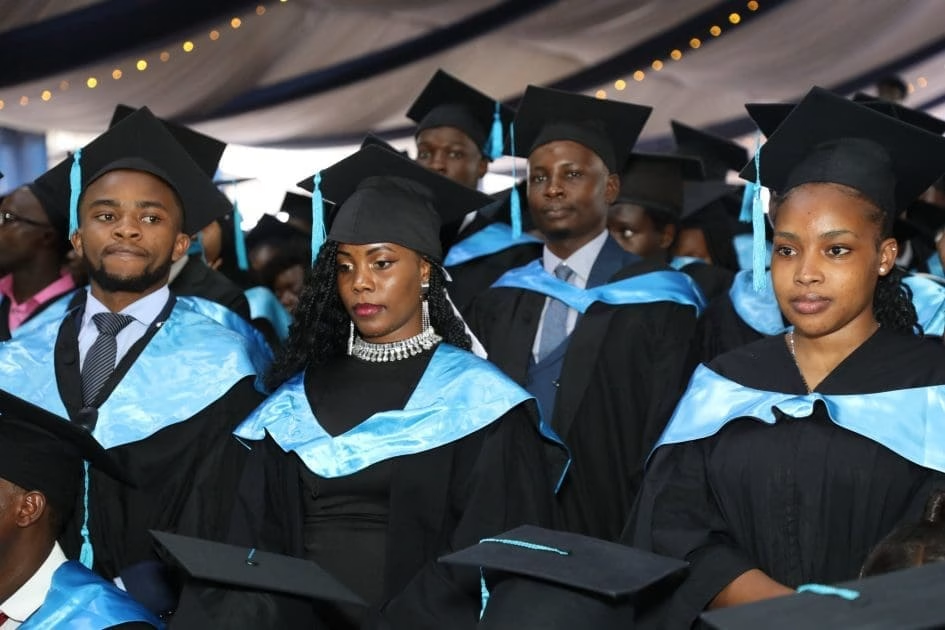
843,623 University Students at Risk of Dropping Out
843,623 University Students at Risk of Dropping Out
The future of university students in the country is uncertain as the government faces a significant funding crisis.
Approximately 843,623 university students are at risk of leaving school due to a Ksh119.8 billion deficit in higher education funding, which impacts grants, scholarships, and loans.
Documents presented to Members of Parliament reveal that only Ksh40.49 billion has been allocated, while Ksh77.58 billion is needed for the New Funding Model (NFM) and Differentiated Unit Cost (DUC) for both public and private universities.
The Higher Education Loans Board (HELB) is also dealing with a Ksh34.4 billion shortfall, putting 474,814 students in jeopardy of losing financial assistance.
Higher Education Principal Secretary Beatrice Inyangala has warned that this funding gap jeopardizes students’ access to education and the financial health of universities.
Auditor General Nancy Gathungu has expressed concerns regarding issues with the Means Testing Instrument (MTI) used to evaluate students’ financial needs, delays in fund distribution, and problems with inclusivity.
The High Court has ruled the NFM unconstitutional, citing its discriminatory nature and its shift of responsibility from the government to parents, further complicating university funding.
Additionally, the Kenya Association of Private Universities (KAPU) has threatened legal action over outstanding debts of Ksh47.1 billion, which have accumulated since 2015 for government-sponsored students enrolled in 34 private universities.
Since 2015, the government, through the Kenya Universities and Colleges Central Placement Service (KUCCPS), has been placing students in private universities to enhance access to higher education.
However, delays in funding for government-sponsored students—many of whom have already graduated—have led to financial difficulties for these universities, affecting both infrastructure development and academic programs.
KAPU Chairman and Vice Chancellor of the Catholic University of Eastern Africa, Prof. Rev. Stephen Ngari, stated last week that the government has failed to fulfill its financial commitments, owing private universities Ksh50 billion in unpaid disbursements.
“This has impacted operations in private universities. We respectfully urge the Government of Kenya to expedite the settlement of the Ksh50 billion in pending bills,” said Prof. Ngari.
Private universities play a vital role in job creation and in providing the skilled workforce necessary for the country’s economic growth.
These institutions not only contribute to the educational development of thousands but also engage in initiatives that promote innovation and entrepreneurship.
“By doing so, we help create jobs across various sectors of the economy, addressing youth unemployment—a critical challenge for our national progress,” Prof. Ngari emphasized.
He also noted that private universities offer quality and affordable education, with a strong emphasis on timely graduation.
Prof. Washington Okeyo, VC Management University of Africa said they have experienced multifarious challenges in the absence of the Sh50 billion. Some universities have been forced to take loans to bridge the existing financial gap.
“Private Universities have been providing free education to the students that were placed in the universities by the Kenya Government. This I say because the Sh50 billion was what was supposed to go towards facilitating the students who were placed by the government,” stated Prof. Okeyo.
He revealed that they have not sent the students home and are optimistic the government will remit the money to address the gaps that have affected universities’ infrastructure expansion programmes and recruitment of staff.
At the same time, the State Department for Higher Education and Research faces a major funding shortfall of Ksh122.1 billion for recurrent expenditure in the 2025/2026 financial year, with only Ksh142.3 billion allocated against a requirement of Ksh264.4 billion.
Additionally, the development budget faces a Ksh9.6 billion deficit, receiving just Ksh3.7 billion instead of the required Ksh13.7 billion, potentially affecting key infrastructure and research projects.
This comes after the department received Ksh120.4 billion in the 2024/2025 fiscal year, with Ksh119.2 billion for recurrent expenditure and Ksh1.2 billion for development.
Related Posts
-
 Total TVC Courses, Contacts, Fees, Location and How To Apply
-
 Technical and Vocational Education Training, TVET, institutions in Isiolo County; Contacts, Fees, How to join and Requirements
-
 Emgwen TVC Courses, Contacts, Fees, Location
-
 Chepsirei TVC Courses, Contacts, Fees, Location
-
Africa Nazarene University student online portal
-
 David M. Wambuli TVC Courses, Contacts, Fees, Location