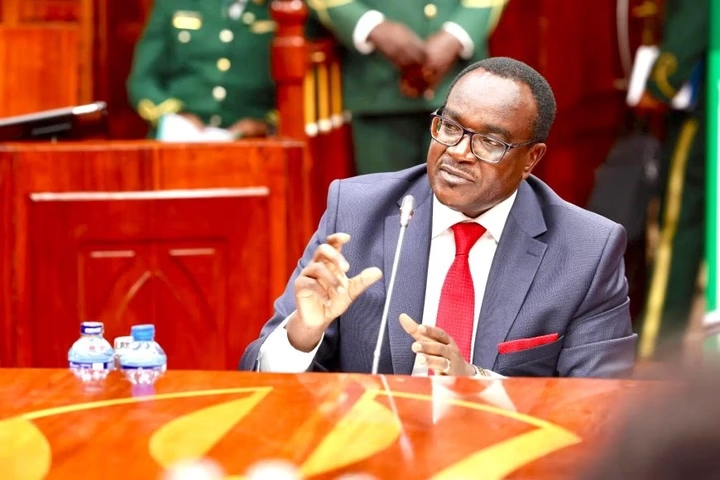
The Principal Secretary for Higher Education and Research, Beatrice Inyangala, struggled to persuade senators that the new university funding model would effectively address the challenges facing higher education in the country.
During her appearance before the Senate Education Committee, Inyangala acknowledged that the new funding model was encountering significant issues due to insufficient funding, students’ reluctance to disclose their vulnerability status, and allegations of bribery.
In a session led by nominated Senator Margaret Kamar, she explained that the Ministry’s assumption that students from National schools could afford their university education did not produce reliable data.
“Categorizing students into different bands has proven difficult because the Ministry of Education has been unable to gather accurate information regarding students’ vulnerability and their families’ actual income,” Inyangala stated.



She noted that a survey conducted by the Ministry revealed that 53 percent of students had left their forms at cyber cafés to be completed by staff, which compromised the integrity of the data collected for proper student placement.
The Higher Education PS pointed out that there was an expectation that students from National Schools would fit into band three, but this assumption was flawed since some were receiving bursaries.
Laikipia Senator John Kinyua questioned why the Education Ministry did not collaborate with local chiefs to gather data on student vulnerability, which could have helped avoid the difficulties they encountered in obtaining accurate information.
Nyandarua Senator John Methu expressed concern that the model has made university education prohibitively expensive, noting that under the Differentiated Unit Cost (DUC), students paid only Sh16,000, whereas under the New Funding Model (NFM), the same students would be required to pay Sh90,000.
“This new funding model has increased the cost of university education, making it unaffordable for many students instead of alleviating financial barriers,” Methu asserted.
Kajiado Senator Lenku Seki asked whether the Ministry had conducted sufficient outreach, particularly in marginalized areas, to ensure students could apply correctly for placement in appropriate bands based on their financial situation.
“We want to know what the Ministry of Education has done in regions like Turkana and Samburu, where many families cannot afford the bands their children have been assigned,” Seki inquired.
Inyangala informed the committee that the Ministry established parameters for student placement based on income brackets, poverty indices, and the number of children in primary and secondary education.
She concluded by stating that the New Funding Model was designed to improve equity and efficiency compared to the previous funding framework based on the Differentiated Unit Cost.
“The New Funding Model encourages exclusivity by reducing financial barriers that limit access to programs that students qualify to pursue, this model was implemented in a context where 23 out of 40 public universities were technically insolvent,” said Inyangala
She informed Senators that its implementation has increased the flow of funds to universities and is projected to resolve the funding crisis in universities and that given time it would be the best model ever to be introduced.
According to Inyangala, 91,881 out of 145,514 student representing 63 per cent are distributed in Bands 1, 2 and 3 and that a majority of the students representing 73 per cent 132,430 students out of 145,514 pay fees of Sh60,000 or less each year.
Currently, students paying Sh30,000 and below are 54,274 representing 37 per cent, those paying between 30,001 and 60,000 are 52,169 (36 per cent), those paying Sh60,001-Sh90,000 are 25,987 while those that pay Sh90,001 and above are 13,084 representing only 8 per cent respectively.