Free Education Funding in Jeopardy as Government Faces Sh64 Billion Debt to Schools
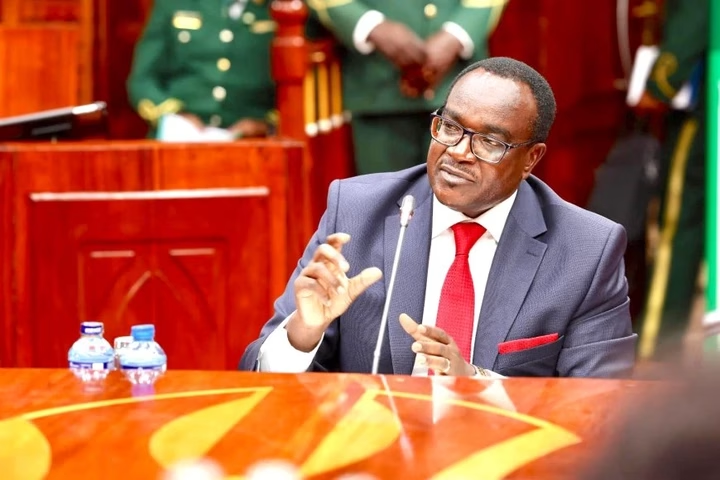
A looming financial crisis is casting a shadow over public schools nationwide, as Education Cabinet Secretary Migos Ogamba finds himself under intense scrutiny in Parliament for significant delays and deficits in the distribution of capitation funds.
During his appearance before the National Assembly Committee on Education, CS Ogamba acknowledged that the Ministry of Education does not have a confirmed total for the outstanding debts owed to schools. However, lawmakers estimate that these arrears could reach a staggering Sh64 billion, accrued over several years.
“I didn’t bring that figure with me. The amount mentioned by Hon. Robert Mbui—Sh64 billion—could indeed be accurate. The pressing question now is: how do we address this, especially when we are still not receiving the budgeted amounts?” Ogamba questioned.
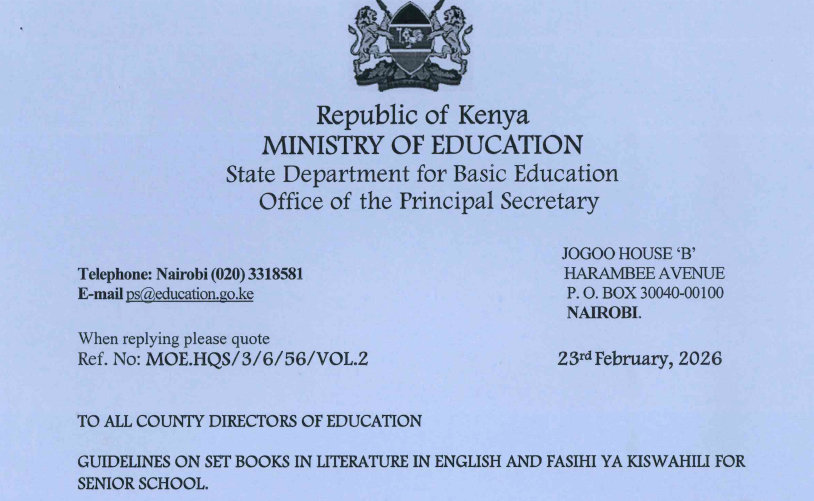
Documents submitted to the committee indicated that the approved annual capitation for secondary school students stands at Sh22,244 per learner. Yet, for Term 1 of 2025, the Ministry only allocated Sh8,818.61 per student, which is merely 50 percent of what was intended.
The Ministry provided Sh28.8 billion to support 3.2 million students, resulting in a shortfall of Sh7.5 billion for the current financial year. Primary schools received an annual allocation of Sh1,420 per learner, distributed in a 50:30:20 ratio each term, which falls significantly short of the Sh2,238 per child recommended by the Presidential Working Party on Education Reform.
Junior secondary schools also faced funding challenges, receiving only half of the Sh15,043 allocated annually per student. Additional information revealed that for co-curricular activities in primary schools, just Sh36 of the Sh76 designated per learner actually reaches the schools, with the remaining Sh40 retained by the Ministry for national-level initiatives. This allocation, which is less than 50 percent of the total per child, has drawn criticism from lawmakers who are questioning the oversight and quality assurance of school programs.
Members of Parliament expressed grave concern over the deteriorating state of school financing, warning that the viability of the country’s free education policy is in jeopardy due to the National Treasury’s delayed disbursements. Committee Chairperson Julius Melly questioned whether the nation could sustain free education amidst rising student enrollment and stagnant funding.
“We made a commitment to provide free and fair education. But can we genuinely uphold this promise with increasing numbers and limited resources?” Melly asked.
Deputy Minority Leader Robert Mbui, who initially raised concerns about the delayed capitation, argued that the government must be transparent about the situation and inform parents that the free education policy is no longer feasible.
“It’s time we face the reality that free education is unsustainable under the current constraints. It would be more honest to introduce cost-sharing with parents rather than perpetuating the illusion of free education,” Mbui asserted.
Narok Woman Representative Rebecca Tonkei echoed the sentiment, highlighting that school leaders are being compelled to operate with inadequate resources while the government fails to intervene.
“How free is education in Kenya when principals are expected to manage with whatever they have, even when it is insufficient?” she questioned.
Kibra MP Peter Orero sharply criticized the Ministry for penalizing school administrators who attempt to address funding shortages through additional fees.
“For the past decade, schools have not received full capitation. Each learner is short by approximately Sh9,000 annually. Yet, when headteachers raise concerns or seek alternatives, they face interdiction and victimization,” Orero stated.
The Ministry attributed the delays in fund disbursement to late releases from the National Treasury and inaccuracies in school submissions to the National Education Management Information System (NEMIS).
CS Ogamba urged lawmakers to support the protection of education funds, arguing that doing so would help shield school financing from frequent disruptions and delays.
“We must prioritize education funding as mandated by the Constitution. Safeguarding the education budget will help alleviate the persistent shortfalls affecting students and schools,” he emphasized.
Ogamba acknowledged that operational challenges stemming from delayed funding were impacting both academic and co-curricular programs but reaffirmed the government’s commitment to free education.
“When it comes to whether we have free education in this country, the short answer is yes. However, we are facing significant challenges that require urgent attention,” he concluded.