Knec explains how Mobile Phones are used to cheat in KCSE Exams
Mobile Phones continue to pose a major challenge in the effective administration of national examinations in the country.
According to the Kenya National Examinations Council (KNEC), invigilators, school administrators, and even non‐teaching staff, such as cooks, are required to surrender their mobile phones, which are then to be securely locked away until the end of the examination period.
Despite the directive, KNEC CEO David Njengere noted that compliance remains inconsistent, undermining the integrity of the process.
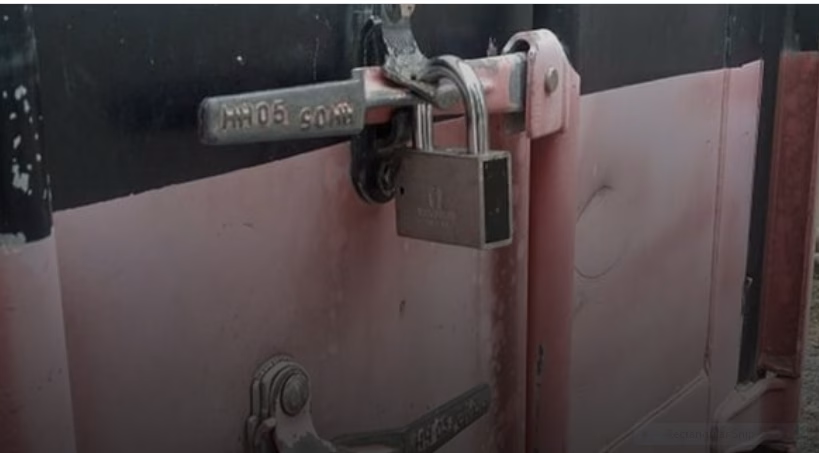
“We are emphasising the rules that will help us secure the integrity of our examinations. We have issued a circular to everyone in the spaces where the exams are being administered that they must surrender their phones,” he said while overseeing the opening of the exam container in Thika, Kiambu County, on Monday, November 3, 2025.



“Everyone, including centre managers, cooks, invigilators, groundsmen, and even security, must surrender their phones, which are locked until the exam materials are taken back to the examination container.”
Beyond mobile phones, he revealed that the logistics of administering exams in flood-prone zones continue to be a hurdle.
Njegere, however, noted that KNEC has responded by mobilising aircraft to ferry exam materials to and from affected areas, ensuring that the delivery and collection of scripts remain undisturbed even when roads become impassable.
“We have deployed adequate helicopters in the flood-prone areas to help us drop and collect the exam materials once the candidates are done,” he added.
Tackling exam malpractice
In addition, to prevent early exposure of exam papers, he revealed that the council now releases the examination materials only after the first paper has been sat.
He emphasised that once the paper is completed, the materials are immediately returned to secure containers.
The 2025 examination season is one of the largest in Kenyan history, with a total of 3,424,836 candidates sitting the national assessments.
996,078 students are sitting their Kenya Certificate of Secondary Education (KCSE), while 1,298,089 are handling the Kenya Primary School Education Assessment (KPSEA).
On the other hand, 1,130,669 pupils are sitting their inaugural Kenya Junior School Education Assessment (KJSEA) under the Competency-Based Curriculum.
Knec explains how Mobile Phones are used to cheat in KCSE Exams
Mobile Phones continue to pose a major challenge in the effective administration of national examinations in the country.
According to the Kenya National Examinations Council (KNEC), invigilators, school administrators, and even non‐teaching staff, such as cooks, are required to surrender their mobile phones, which are then to be securely locked away until the end of the examination period.
Despite the directive, KNEC CEO David Njengere noted that compliance remains inconsistent, undermining the integrity of the process.
“We are emphasising the rules that will help us secure the integrity of our examinations. We have issued a circular to everyone in the spaces where the exams are being administered that they must surrender their phones,” he said while overseeing the opening of the exam container in Thika, Kiambu County, on Monday, November 3, 2025.
“Everyone, including centre managers, cooks, invigilators, groundsmen, and even security, must surrender their phones, which are locked until the exam materials are taken back to the examination container.”
Beyond mobile phones, he revealed that the logistics of administering exams in flood-prone zones continue to be a hurdle.
Njegere, however, noted that KNEC has responded by mobilising aircraft to ferry exam materials to and from affected areas, ensuring that the delivery and collection of scripts remain undisturbed even when roads become impassable.
“We have deployed adequate helicopters in the flood-prone areas to help us drop and collect the exam materials once the candidates are done,” he added.
Tackling exam malpractice
In addition, to prevent early exposure of exam papers, he revealed that the council now releases the examination materials only after the first paper has been sat.
He emphasised that once the paper is completed, the materials are immediately returned to secure containers.
The 2025 examination season is one of the largest in Kenyan history, with a total of 3,424,836 candidates sitting the national assessments.
996,078 students are sitting their Kenya Certificate of Secondary Education (KCSE), while 1,298,089 are handling the Kenya Primary School Education Assessment (KPSEA).
On the other hand, 1,130,669 pupils are sitting their inaugural Kenya Junior School Education Assessment (KJSEA) under the Competency-Based Curriculum.