KNEC Invites Applications for Teacher Exam Markers
The Kenya National Examinations Council (KNEC) has officially opened applications for college educators interested in becoming examiners for teacher education assessments.
In a notice released on Tuesday, April 1, 2025, KNEC is encouraging tutors to apply for training that will equip them to mark exams later this month.
KNEC has stated that those selected for the training will need to pay a fee of Ksh 10,500. However, this fee will only apply to shortlisted candidates, who will be informed via SMS and through the portal with further instructions on how to proceed with the payment.


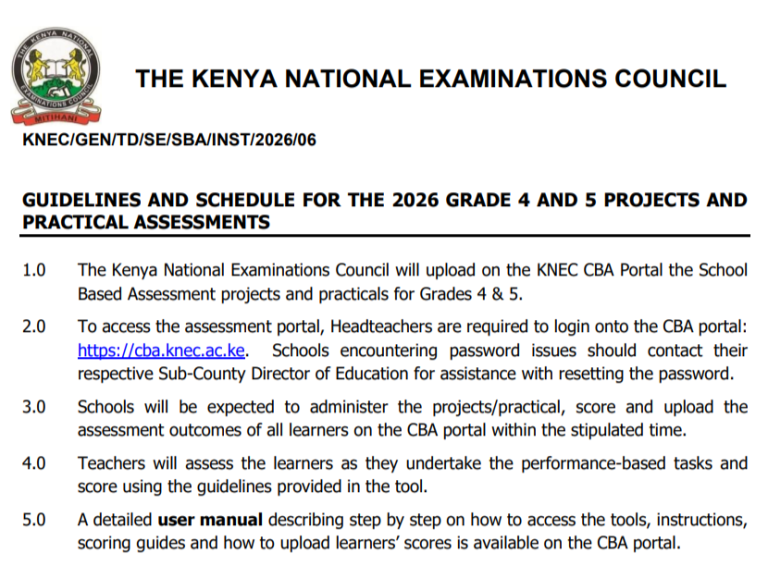

“The training fee is set at Sh10,500 and will only be required from shortlisted applicants, who will receive notifications via text message (SMS) and the portal regarding payment procedures,” KNEC noted in the announcement.
The training will consist of both online and in-person components. KNEC mentioned that additional information regarding online resources, the schedule for in-person training, and the venue will be provided to shortlisted candidates at a later date.
“Details about accessing online training materials, along with the dates and location for the in-person training, will be communicated to the selected trainees later,” KNEC stated.
It’s crucial to understand that qualifying for the training does not guarantee a position as an examiner. KNEC will choose examiners based on the specific staffing needs for each examination paper. The council emphasized that “successfully qualifying for the training does not ensure employment.”
Tutors who possess qualifications such as a Diploma in Secondary Teacher Education (DSTE), Diploma in Primary Teacher Education (DPTE), or Diploma in Early Childhood Teacher Education (DECTE) and are already registered in the KNEC database do not need to apply.
The training will encompass a variety of subjects for the DSTE and DTE programs, including languages like English, Literature, Arabic, French, and German, as well as core sciences such as Chemistry, Physics, and Biology. Additional subjects will include Geography, Life Skills Education, Fine Art, Visual Arts, Music, Dance, Performing Arts, Theatre, and Film.
Moreover, the training will address specialized areas such as Wood Technology, Electrical Technology, Pre-Technical Studies, and Textile Design Technology, along with essential topics like Environmental Education, Physical and Health Education, and Health and Nutrition.
Other subjects included in the training are Religious Studies, Child Development, Psychology, Social Studies, Indigenous Languages, Art and Craft, Agriculture, and Science and Technology.