KNEC Sets Deadline for KJSEA Nominal Roll Submissions by May 9th
The Kenya National Examinations Council (KNEC) has issued a directive for schools to submit the nominal rolls for the 2025 Kenya Junior School Education Assessment (KJSEA) by this Friday.
These nominal rolls are created once students are registered on the KNEC platform, with the registration for Grade 9 learners concluding on March 28th. Schools must send these rolls along with additional documents to the Sub County Directors of Education to finalize their center registration for the forthcoming assessments.
Heads of Institutions (HOIs) are tasked with submitting a return envelope and a declaration form for both regular and special schools. The declaration form requires school leaders to verify that candidates’ names are accurate and free from duplication, ensuring that all students have assessment numbers. They must also confirm that subject entries for candidates with special needs and those opting for Religious Education are correctly recorded. The return envelope should include the school’s contact details and the Headteacher’s information.

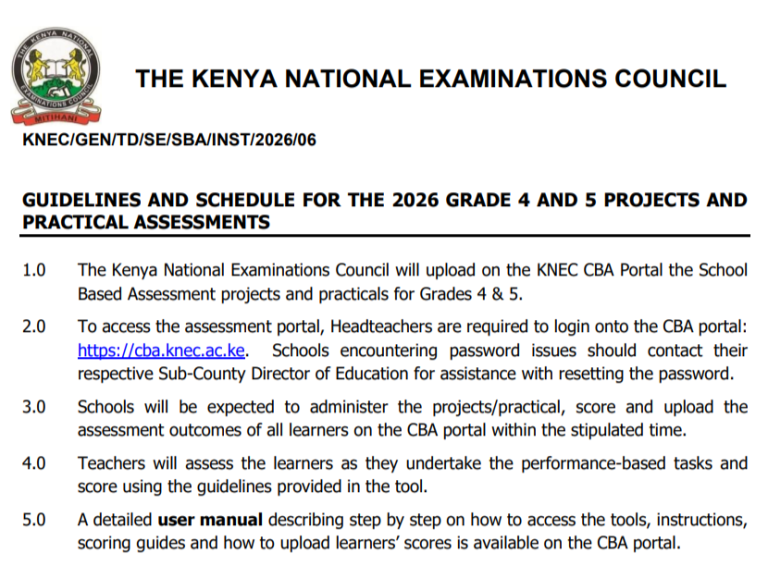

The Grade 9 KJSEA candidates will embark on their national assessment journey alongside Grade 6 KPSEA starting October 27th this year. The KPSEA will span four days from October 27th to 30th, while the KJSEA will extend over nine days, concluding on November 6th. However, the national assessments will kick off with project work from May to July, beginning with Creative Arts and Sports in May, followed by a Pre-Technical Studies project in July. KNEC will provide schools with the project guidelines.
KNEC has already trained examiners who will assess this year’s KJSEA, with the training taking place in April. Over four million candidates are anticipated to participate in various assessments across four levels: KCSE, KPSEA, KJSEA, and the Kenya Pre-Vocational Level Education Assessment (KPLEA), presenting logistical and educational challenges for KNEC. This year marks the inaugural administration of KJSEA and KPLEA, with concerns surrounding the complexity and novelty of the papers, as well as the large number of students involved.
In line with the Competency Based Curriculum (CBC) transition plan, 60% of the Grade 9 score will derive from the KJSEA, with 20% from School-Based Assessments in Grades 7 and 8, and another 20% from KPSEA. Notably, Mathematics will no longer be a mandatory subject for students advancing to senior secondary school, marking a significant shift under the CBC, now referred to as Competency Based Education (CBE). Instead, students must take English or Kenya Sign Language, Kiswahili, Physical Education, and Community Service Learning as core subjects, while selecting from a diverse array of 38 options to shape their academic and career paths.
This represents a departure from the previous 8-4-4 system, where Mathematics was a core subject alongside English, Kiswahili, and at least two sciences (Physics, Chemistry, or Biology). Basic Education Principal Secretary Belio Kipsang announced that Grade 9 learners—the first cohort under CBC—will begin choosing their subjects and senior schools in the second term of this year. “We want to give them time to consult with their parents about their interests and aspirations. The selection process will commence as soon as they return to school,” he stated.
Additionally, the Ministry of Education has suggested capping the number of students from a single junior secondary school entering the same senior school to a maximum of five, aiming to foster diversity in placements. However, some stakeholders believe this may be overly ambitious, particularly for day schools that draw students from local communities.
KNEC has clarified that the final Grade 9 score will be determined by students’ performance in primary school, internal assessments conducted by teachers, and their results in the national KJSEA at year’s end. The KJSEA will account for 60% of the final score, influencing the student’s placement in senior secondary school. The remaining 40% will be evenly divided between scores from internal assessments and primary school performance.
Students who are unhappy with their placements will have the chance to request transfers, subject to available spaces upon reporting. For private candidates—those not enrolled in formal educational institutions—placement will only be available in day senior secondary schools.
Senior schools will now be categorized into three main academic pathways to accommodate the diverse interests and abilities of learners. Triple Pathway Schools will offer three distinct learning areas: science, technology, engineering, and mathematics (STEM), social sciences, and arts and sports. Students will choose a pathway that aligns with their strengths and aspirations rather than being required to take all three.
Double Pathway Schools will offer either STEM and social sciences or STEM and arts. Meanwhile, Vocational and Special Needs Pathway Schools will focus on learners with disabilities, such as autism and cerebral palsy, providing hands-on vocational training tailored to their unique abilities.
To further streamline the placement process, the ministry has classified senior schools into three types based on accommodation: day schools, hybrid schools (which accommodate both boarding and day students), and special needs schools that exclusively serve learners with hearing, visual, or physical impairments, equipped with the necessary resources to support them.