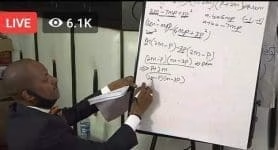
Embakasi East MP Babu Owino during his Maths lesson on Facebook.
Read all the form 1 notes here. You can also download a copy of the pdf notes on this link; MATH FORM ONE NOTES
form 3 notes for all subjects; free pdf & word downloads
Form 2 notes for all subjects free download
Form one notes for all subjects free download
FREE FORM 1 NOTES DOWNLOADS FOR SECONDARY SCHOOLS: ALL SUBJECTS FREE EDITABLE NOTES
CHAPTER ONE
Specific Objectives
By the end of the topic the learner should be able to:
Content
Introduction
Place value
A digit have a different value in a number because of its position in a number. The position of a digit in a number is called its place value.
Total value
This is the product of the digit and its place value.
Example
| Number | Hundred Millions | Ten Millions | Millions | Hundred Thousands | Ten Thousands | Thousands | Hundred | Tens | ones |
| 345,678,901 | 3 | 4 | 5 | 6 | 7 | 8 | 9 | 0 | 1 |
| 769,301,854 | 7 | 6 | 9 | 3 | 0 | 1 | 8 | 5 | 4 |
| 902,350,409 | 9 | 0 | 2 | 3 | 5 | 0 | 4 | 0 | 9 |
A place value chart can be used to identify both place value and total value of a digit in a number. The place value chart is also used in writing numbers in words.
Example
Billions
A billion is one thousands million, written as 1, 000, 000,000.There are ten places in a billion.
Example
What is the place value and total value of the digits below?
Solution
Rounding off
When rounding off to the nearest ten, the ones digit determines the ten i.e. if the ones digit is 1, 2, 3, or 4 the nearest ten is the ten number being considered. If the ones digit is 5 or more the nearest ten is the next ten or rounded up.
Thus 641 to the nearest ten is 640, 3189 to the nearest is 3190.
When rounding off to the nearest 100, then the last two digits or numbers end with 1 to 49 round off downwards. Number ending with 50 to 99 are rounded up.
Thus 641 to the nearest hundred is 600, 3189 is 3200.
Example
Rounding off each of the following numbers to the nearest number indicated in the bracket:
Solution
Operations on whole Numbers
Addition
Example
Find out:
Solution
Arrange the numbers in vertical forms
98
6734
+ 348
7180
6349
259
+ 79542
86150
Subtracting
Example
Find: 73469 – 8971
Solution
73469
64498
Multiplication
The product is the result of two or more numbers.
Example
Work out: 469 x 63
Solution
469
X 63
1407
+ 28140
29547
Division
When a number is divided by the result is called the quotient. The number being divided is the divided and the number dividing is the divisor.
Example
Find: 6493 14
Solution
We get 463 and 11 is the remainder
Note:
6493 = (463 x 14) + 11
In general, dividend = quotient x division + remainder.
| Operation | Words |
| Addition | sum plus added more than increased by |
| Subtraction | difference minus subtracted from less than decreased by reduced by deducted from |
| Multiplication | product of multiply times twice thrice |
| Division | quotient of divided by |
| Equal | equal to result is is |
Word problem
In working the word problems, the information given must be read and understood well before attempting the question.
The problem should be broken down into steps and identify each other operations required.
Example
Otego had 3469 bags of maize, each weighing 90 kg. He sold 2654 of them.
Solution
3469 bags weigh 3469 x 90 = 312,210 kg
2654 bags weigh 2654 x 90 = 238,860 kg
Amount of maize left = 312,210 – 238,860
= 73,350 kg.
=1283
Even Number
A number which can be divided by 2 without a remainder E.g. 0,2,4,6 0 or 8
3600, 7800, 806, 78346
Odd Number
Any number that when divided by 2 gives a remainder. E.g. 471,123, 1197,7129.The numbers ends with the following digits 1, 3, 5,7 or 9.
Prime Number
A prime number is a number that has only two factors one and the number itself.
For example, 2, 3, 5, 7, 11, 13, 17 and 19.
Note:
End of topic
| Did you understand everything? If not ask a teacher, friends or anybody and make sure you understand before going to sleep! |
Past KCSE Questions on the topic
CHAPTER TWO
Specific Objectives
By the end of the topic the learner should be able to:
Content
Introduction
Definition
A factor is a number that divides another number without a remainder.
| Number | Factors |
| 12 | 1,2,3,4,6,12 |
| 16 | 1,2,4,8,16 |
| 39 | 1 ,3,13,39 |
A natural number with only two factors, one and itself is a prime number. Or any number that only can be divided by 1 and itself. Prime numbers have exactly 2 different factors.
Prime Numbers up to 100.
| 2 | 3 | 5 | 7 | 11 |
| 13 | 17 | 19 | 23 | 29 |
| 31 | 37 | 41 | 43 | 47 |
| 53 | 59 | 61 | 67 | 71 |
| 73 | 79 | 83 | 89 | 97 |
Composite numbers
Any number that has more factors than just itself and 1.They can be said to be natural number other than 1 which are not prime numbers.They can be expressed as a product of two or more prime factors.
9 = 3 x 3
12 = 2 x 2 x 3
105 = 3 x 5 x 7
The same number can be repeated several times in some situations.
32 = 2 x 2 x 2 x 2 x 2 =
72 =2 x 2 x 2 x 3 x 3 =
To express a number in terms of prime factors ,it is best to take the numbers from the smallest and divide by each of them as many times as possible before going to the next.
Example
Express the following numbers in terms of their prime factors
Solution
| 2 | 300 |
| 2 | 150 |
| 3 | 75 |
| 5 | 25 |
| 5 | 5 |
| 1 |
300 = 2 x 2 x 3 x 5 x 5
=
| 2 | 196 |
| 2 | 98 |
| 7 | 49 |
| 7 | 7 |
| 1 |
196 = 2 x 2 x 7 x 7
=
Exceptions
The numbers 1 and 0 are neither prime nor composite. 1 cannot be prime or composite because it only has one factor, itself. 0 is neither a prime nor a composite number because it has infinite factors. All other numbers, whether prime or composite, have a set number of factors. 0 does not follow the rules.
End of topic
| Did you understand everything? If not ask a teacher, friends or anybody and make sure you understand before going to sleep! |
Past KCSE Questions on the topic
Hence evaluate: 14702
7056
Leaving the answer in prime factor form
(a) Write down the number formed
(b) What is the total value of the second digit?
CHAPTER THREE
Specific Objectives
By the end of the topic the learner should be able to:
The learner should be able to test the divisibility of numbers by 2, 3, 4, 5, 6, 8, 9, 10 and 11.
48
Content
Divisibility test of numbers by 2, 3, 4, 5, 6, 8, 9, 10 and 11
Introduction
Divisibility test makes computation on numbers easier. The following is a table for divisibility test.
| Divisibility Tests | Example |
| A number is divisible by 2 if the last digit is 0, 2, 4, 6 or 8. | 168 is divisible by 2 since the last digit is 8. |
| A number is divisible by 3 if the sum of the digits is divisible by 3. | 168 is divisible by 3 since the sum of the digits is 15 (1+6+8=15), and 15 is divisible by 3. |
| A number is divisible by 4 if the number formed by the last two digits is divisible by 4. | 316 is divisible by 4 since 16 is divisible by 4. |
| A number is divisible by 5 if the last digit is either 0 or 5. | 195 is divisible by 5 since the last digit is 5. |
| A number is divisible by 6 if it is divisible by 2 AND it is divisible by 3. | 168 is divisible by 6 since it is divisible by 2 AND it is divisible by 3. |
| A number is divisible by 8 if the number formed by the last three digits is divisible by 8. | 7,120 is divisible by 8 since 120 is divisible by 8. |
| A number is divisible by 9 if the sum of the digits is divisible by 9. | 549 is divisible by 9 since the sum of the digits is 18 (5+4+9=18), and 18 is divisible by 9. |
| A number is divisible by 10 if the last digit is 0. | 1,470 is divisible by 10 since the last digit is 0. |
| A number is divisible by 11 if the sum of its digits in the odd positons like 1st ,3rd ,5th ,7th Positions, and the sum of its digits in the even position like 2nd , 4th ,6th ,8th positions are equal or differ by 11,or by a multiple of 11 | 8,260,439 sum of 8 +6 +4 +9 =27: 2 + 0 +3 = 5 ; 27 – 5 = 22 which is a multiple of 11 |
End of topic
| Did you understand everything? If not ask a teacher, friends or anybody and make sure you understand before going to sleep! |
Past KCSE Questions on the topic
CHAPTER FOUR
Specific Objectives
By the end of the topic the learner should be able to:
Content
Introduction
A Greatest Common Divisor is the largest number that is a factor of two or more numbers.
When looking for the Greatest Common Factor, you are only looking for the COMMON factors contained in both numbers. To find the G.C.D of two or more numbers, you first list the factors of the given numbers, identify common factors and state the greatest among them.
The G.C.D can also be obtained by first expressing each number as a product of its prime factors. The factors which are common are determined and their product obtained.
Example
Find the Greatest Common Factor/GCD for 36 and 54 is 18.
Solution
The prime factorization for 36 is 2 x 2 x 3 x 3.
The prime factorization for 54 is 2 x 3 x 3 x 3.
They both have in common the factors 2, 3, 3 and their product is 18.
That is why the greatest common factor for 36 and 54 is 18.
Example
Find the G.C.D of 72, 96, and 300
Solution
| 72 | 96 | 300 | |
| 2 | 36 | 48 | 150 |
| 2 | 18 | 24 | 75 |
| 3 | 6 | 8 | 25 |
End of topic
| Did you understand everything? If not ask a teacher, friends or anybody and make sure you understand before going to sleep! |
Past KCSE Questions on the topic
CHAPTER FIVE
Specific Objectives
By the end of the topic the learner should be able to:
Content
Introduction
Definition
LCM or LCF is the smallest multiple that two or more numbers divide into evenly i.e. without a remainder. A multiple of a number is the product of the original number with another number.
Some multiples of 4 are 4, 8, 12, 16, 20, 24, 28, 32, 36, 40, 44, 48, 52, 56 …
Some multiples of 7 are 7, 14, 21, 28, 35, 42, 49, 56 …
A Common Multiple is a number that is divisible by two or more numbers. Some common multiples of 4 and 7 are 28, 56, 84, and 112.
When looking for the Least Common Multiple, you are looking for the smallest multiple that they both divide into evenly. The least common multiple of 4 and 7 is 28.
Example
Find the L.C.M of 8, 12, 18 and 20.
Solution
| 8 | 18 | 20 | |
| 2 | 4 | 6 | 10 |
| 2 | 2 | 3 | 5 |
| 2 | 1 | 3 | 5 |
| 3 | 1 | 1 | 5 |
| 3 | 1 | 1 | 5 |
| 5 | 1 | 1 | 1 |
The L.C.M is the product of all the divisions used.
Therefore, L.C.M. of 8, 12, 18 and 20 = 2 x 2 x 2 x 3 x 3 x5
= x 5
= 360
Note;
Unlike the G.C.D tables, if the divisor /factor does not divide a number exactly, then the number is retained, e.g., 2 does not divide 9 exactly, therefore 9 is retained .The last row must have all values 1.
End of topic
| Did you understand everything? If not ask a teacher, friends or anybody and make sure you understand before going to sleep! |
Past KCSE Questions on the topic
Leave 7 acres for grazing. Determine the smallest size of such land.
A number m is such that when it is divided by 30, 36, and 45, the remainder is always 7. Find the smallest possible value of m.
CHAPTER SIX
Specific Objectives
By the end of the topic the learner should be able to:
Content
Introduction
The Number Line
Integers are whole numbers, negative whole numbers and zero. Integers are always represented on the number line at equal intervals which are equal to one unit.
Operations on Integers
Addition of Integers
Addition of integers can be represented on a number line .For example, to add
+3 to 0 , we begin at 0 and move 3 units to the right as shown below in red to get +3, Also to add + 4 to +3 we move 4 units to the right as shown in blue to get +7.
To add -3 to zero we move 3 units to the left as shown in red below to get -3 while to add -2 to -3 we move 2 steps to the left as shown in blue to get -5.
| Note; ü When adding positive numbers we move to the right. ü When dealing with negative we move to the left. Subtraction of integers. |
Example
(+7) – (0) = (+7)
To subtract +7 from 0 ,we find a number n which when added to get 0 we get +7 and in this case n = +7 as shown above in red.
Example
(+2) – (+7) = (-5)
Start at +7 and move to +2. 5 steps will be made towards the left. The answer is therefore -5.
Example
-3 – (+6) = -9
|__|__|__|__|__|__|__|__|__|__|__|__|__|__|
-4 -3 -2 -1 0 1 2 3 4 5 6 7 8 9 10
We start at +6 and moves to -3. 9 steps to the left, the answer is -9.
Note:
4 – (+3) = 4 -3
= 1
-3- (+6) =3 – 6
= -3
2 – (- 4) = 2 + 4
= 6
(-5) – (- 1) = -5 + 2
= -3
Multiplication
In general
Examples
-6 x 5 = -30
7 x -4 = – 28
-3 x -3 = 9
-2 x -9 = 18
Division
Division is the inverse of multiplication. In general
Note;
For multiplication and division of integer:
Order of operations
BODMAS is always used to show as the order of operations.
B – Bracket first.
O – Of is second.
D – Division is third.
M – Multiplication is fourth.
A – Addition is fifth.
S – Subtraction is considered last.
Example
6 x 3 – 4
Solution
Use BODMAS
(2 – 1) = 1 we solve brackets first
(4) = 2 we then solve division
(6 x 3) = 18 next is multiplication
Bring them together
18 – 2 +5 +1 = 22 we solve addition first and lastly subtraction
18 + 6 – 2 = 22
End of topic
| Did you understand everything? If not ask a teacher, friends or anybody and make sure you understand before going to sleep! |
Past KCSE Questions on the topic
1.) The sum of two numbers exceeds their product by one. Their difference is equal to their product less five. Find the two numbers. (3mks)
2.) 3x – 1 > -4
2x + 1≤ 7
3.) Evaluate -12 ÷ (-3) x 4 – (-15)
-5 x 6 ÷ 2 + (-5)
4.) Without using a calculator/mathematical tables, evaluate leaving your answer as a simple fraction
(-4)(-2) + (-12) ¸ (+3) + -20 + (+4) + -6)
-9 – (15) 46- (8+2)-3
| |
| |
5.) Evaluate -8 ¸ 2 + 12 x 9 – 4 x 6
6.) Evaluate without using mathematical tables or the calculator
1.9 x 0.032
20 x 0.0038
CHAPTER SEVEN
Specific Objectives
By the end of the topic the learner should be able to:
Content
Introduction
A fraction is written in the form where a and b are numbers and b is not equal to 0.The upper number is called the numerator and the lower number is the denominator.
Proper fraction
In proper fraction the numerator is smaller than the denominator. E.g.
Improper fraction
The numerator is bigger than or equal to denominator. E.g.
Mixed fraction
An improper fraction written as the sum of an integer and a proper fraction. For example
=
Changing a Mixed Number to an Improper Fraction
Mixed number – 4 (contains a whole number and a fraction)
Improper fraction – (numerator is larger than denominator)
Step 1 – Multiply the denominator and the whole number
Step 2 – Add this answer to the numerator; this becomes the new numerator
Step 3 – Carry the original denominator over
Example
3 = 3 × 8 + 1 = 25
=
Example
=
Changing an Improper Fraction to a Mixed Number
Step 1– Divide the numerator by the denominator
Step 2– The answer from step 1 becomes the whole number
Step 3– The remainder becomes the new numerator
Step 4– The original denominator carries over
Example
= 47 ÷ 5 or
5 = 5 = 9
2
Example
= 2 = 2 = 4 ½
Comparing Fractions
When comparing fractions, they are first converted into their equivalent forms using the same denominator.
Equivalent Fractions
To get the equivalent fractions, we multiply or divide the numerator and denominator of a given fraction by the same number. When the fraction has no factor in common other than 1, the fraction is said to be in its simplest form.
Example
Arrange the following fractions in ascending order (from the smallest to the biggest):
1/2 1 /4 5/6 2/3
Step 1: Change all the fractions to the same denominator.
Step 2: In this case we will use 12 because 2, 4, 6, and3 all go into i.e. We get 12 by finding the L.C.M of the denominators. To get the equivalent fractions divide the denominator by the L.C.M and then multiply both the numerator and denominator by the answer,
For ½ we divide 12 2 = 6, then multiply both the numerator and denominator by 6 as shown below.
1 x 6 1x3 5 x2 2 x4
2 x6 4 x3 6 x2 3 x4
Step3: The fractions will now be:
6/12 3/12 10/12 8/12
Step 4: Now put your fractions in order (smallest to biggest.)
3/12 6/12 8/12 10/12
Step 5: Change back, keeping them in order.
1/4 1/2 2/3 5/6
You can also use percentages to compare fractions as shown below.
Example
Arrange the following in descending order (from the biggest)
5/12 7 /3 11/5 9 /4
Solution
X 100 = 41.67%
X 100 = 233.3%
X 100 = 220%
X 100 = 225%
7/3, 9/4, 11/5, 5/12
Operation on Fractions
Addition and Subtraction
The numerators of fractions whose denominators are equal can be added or subtracted directly.
Example
2/7 + 3/7 = 5/7
6/8 – 5/8 = 1/8
When adding or subtracting numbers with different denominators like:
5/4 + 3 /6=?
2/5 – 2/7 =?
Step 1– Find a common denominator (a number that both denominators will go into or L.C.M)
Step 2– Divide the denominator of each fraction by the common denominator or L.C.M and then multiply the answers by the numerator of each fraction
Step 3– Add or subtract the numerators as indicated by the operation sign
Step 4 – Change the answer to lowest terms
Example
+ = Common denominator is 8 because both 2 and 8 will go into 8
+ =
Which simplifies to 1
Example
4 – = Common denominator is 20 because both 4 and 5 will go into 20
4 = 4
– =
4
Or
4 – = =
Mixed numbers can be added or subtracted easily by first expressing them as improper fractions.
Examples
5
Solution
5 = 5 +
Example
Evaluate
Solution
Multiplying Simple Fractions
Step 1– Multiply the numerators
Step 2– Multiply the denominators
Step 3– Reduce the answer to lowest terms by dividing by common divisors
Example
× = which reduces to
Multiplying Mixed Numbers
Step 1– Convert the mixed numbers to improper fractions first
Step 2– Multiply the numerators
Step 3– Multiply the denominators
Step 4– Reduce the answer to lowest terms
Example
2 × 1 = × =
Which then reduces to 3
Note:
When opposing numerators and denominators are divisible by a common number, you may reduce the numerator and denominator before multiplying. In the above example, after converting the mixed numbers to improper fractions, you will see that the 3 in the numerator and the opposing 3 in the denominator could have been reduced by dividing both numbers by 3, resulting in the following reduced fraction:
× = = 3
Dividing Simple Fractions
Step 1– Change division sign to multiplication
Step 2– Change the fraction following the multiplication sign to its reciprocal (rotate the fraction around so the old denominator is the new numerator and the old numerator is the new denominator)
Step 3– Multiply the numerators
Step 4– Multiply the denominators
Step 5– simplify the answer to lowest terms
Example
÷ = becomes × which when solved is
Dividing Mixed Numbers
Step 1 – Convert the mixed number or numbers to improper fraction.
Step 2 – Change the division sign to multiplication.
Step 3– Change the fraction following the multiplication sign to its reciprocal (flip the fraction around so the old denominator is the new numerator and the old numerator is the new denominator)
Step 4– Multiply the numerators.
Step 5– Multiply the denominators.
Step 6– Simplify the answer to lowest form.
Example
3 ÷ 2 = becomes ÷ becomes × =
Which when solved is × = which simplifies to 1
Order of operations on Fractions
The same rules that apply on integers are the same for fractions
BODMAS
Example
15 (we start with of then division)
= 15
= 5
Example
=
Solution
1/3 – 1/4 = (we start with bracket)
(We then work out the outer bracket)
(We then work out the multiplication)
(Addition comes last here)
Example
Evaluate + ½
Solution
We first work out this first
Therefore + ½ = 25 + ½
= 25 ½
Note:
Operations on fractions are performed in the following order.
Example
Evaluate: =
Solution
=
=
=
=
Example
Two pipes A and B can fill an empty tank in 3hrs and 5hrs respectively. Pipe C can empty the tank in 4hrs. If the three pipes A, B and C are opened at the same time find how long it will take for the tank to be full.
Solution
1/3 +1/5 -1/4 = 20+12-15
60
= 17/60
17/60=1hr
1= 1 x 60/17
60/17 = 3.5294118
= 3.529 hrs.
End of topic
| Did you understand everything? If not ask a teacher, friends or anybody and make sure you understand before going to sleep! |
Past KCSE Questions on the topic
Find the number.
84 ¸ -7 + 3 – -5
–8 + (–13) x 3 – (–5)
–1 + (–6) ÷ 2 x 2
¾ of 2½ ¸ ½
2/5¸ ½ of 4/9 – 11/10
1/8 – 1/6 of 3/8
¾ + 12/7 ÷ 3/7 of 21/3
(9/7–3/8) x 2/3
2/5¸ ½ of 4/9 – 1 1/10
1/8 – 1/16 x 3/8
14/5 of 25/18¸12/3 x 24
21/3 – ¼ of 12 ¸5/3 leaving the answer as a fraction in its simplest form
CHAPTER EIGHT
Specific Objectives
By the end of the topic the learner should be able to:
Content
Introduction
A fraction whose denominator can be written as the power of 10 is called a decimal fraction or a decimal. E.g. 1/10, 1/100, 50/1000.
A decimal is always written as follows 1/10 is written as 0.1 while 5/100 is written as 0.05.The dot is called the decimal point.
Numbers after the decimal points are read as single digits e.g. 5.875 is read as five point eight seven five. A decimal fraction such 8.3 means 8 + 3/10.A decimal fraction which represents the sum of a whole number and a proper fraction is called a mixed fraction.
Place value chart
| Ten thousands | Thousands | Hundreds | Tens | Ones | Decimal Point | Tenths | Hundredths | Thousandths | Ten Thousandths | Hundred Thousandths |
| 10,000 | 1,000 | 100 | 10 | 1 | . | .1 | .01 | .001 | .0001 | .00001 |
Decimal to Fractions
To convert a number from fraction form to decimal form, simply divide the numerator (the top number) by the denominator (the bottom number) of the fraction.
Example:
5/8
8¬ Add as many zeros as needed.
48
20
16
40
40
0
Converting a decimal to a fraction
To change a decimal to a fraction, determine the place value of the last number in the decimal. This becomes the denominator. The decimal number becomes the numerator. Then reduce your answer.
Example:
.625 – the 5 is in the thousandths column, therefore,
.625 = = reduces to
Note:
Your denominator will have the same number of zeros as there are decimal digits in the decimal number you started with – .625 has three decimal digits so the denominator will have three zero.
Recurring Decimals
These are decimal fractions in which a digit or a group of digits repeat continuously without ending.
We cannot write all the numbers, we therefore place a dot above a digit that is recurring. If more than one digit recurs in a pattern, we place a dot above the first and the last digit in the pattern.
E.g.
0.3333……………………….is written as 0.
0.4545………………………is written as 0.
0.324324………………….is written as 0.
Any division whose divisor has prime factors other than 2 or 5 forms a recurring decimal or non-terminating decimal.
Example
Express each as a fraction
Solution
10r = 6.6666 ————— (II)
Subtracting I from II
9r = 6
10 r=7.3333333——— (II)
100r = 73.33333——— (III)
Subtracting (II) from (III)
90r = 66
100r = 15.1515 ———– (II)
99r= 15
Decimal places
When the process of carrying out division goes over and over again without ending we may round off the digits to any number of required digits to the right of decimal points which are called decimal places.
Example
Round 2.832 to the nearest hundredth.
Solution
Step 1 – Determine the place to which the number is to be rounded is.
2.832
Step 2 – If the digit to the right of the number to be rounded is less than 5, replace it and all the digits to the right of it by zeros. If the digit to the right of the underlined number is 5 or higher, increase the underlined number by 1 and replace all numbers to the right by zeros. If the zeros are decimal digits, you may eliminate them.
2.832 = 2.830 = 2.83
Example
Round 43.5648 to the nearest thousandth.
Solution
43.5648 = 43.5650 = 43.565
Example
Round 5,897,000 to the nearest hundred thousand.
Solution
5,897,000 = 5,900,000
Standard Form
A number is said to be in standard form if it is expressed in form A X, Where 1 < A <10 and n is an integer.
Example
Write the following numbers in standard form.
Solution
Operation on Decimals
Addition and Subtraction
The key point with addition and subtraction is to line up the decimal points!
Example
2.64 + 11.2 = 2.64
+11.20® in this case, it helps to write 11.2 as 11.20
13.84
Example
14.73 – 12.155 = 14.730 ® again adding this 0 helps
2.575
Example
127.5 + 0.127 = 327.500
+ 0.127
327.627
Multiplication
When multiplying decimals, do the sum as if the decimal points were not there, and then calculate how many numbers were to the right of the decimal point in both the original numbers – next, place the decimal point in your answer so that there are this number of digits to the right of your decimal point?
Example
2.1 x 1.2.
Calculate 21 x 12 = 252. There is one number to the right of the decimal in each of the original numbers, making a total of two. We therefore place our decimal so that there are two digits to the right of the decimal point in our answer.
Hence 2.1 x 1.2 =2.52.
Always look at your answer to see if it is sensible. 2 x 1 = 2, so our answer should be close to 2 rather than 20 or 0.2 which could be the answers obtained by putting the decimal in the wrong place.
Example
1.4 x 6
Calculate 14 x 6 = 84. There is one digit to the right of the decimal in our original numbers so our answer is 8.4
Check 1 x 6 = 6 so our answer should be closer to 6 than 60 or 0.6
Division
When dividing decimals, the first step is to write your numbers as a fraction. Note that the symbol / is used to denote division in these notes.
Hence 2.14 / 1.2 = 2.14
1.2
Next, move the decimal point to the right until both numbers are no longer decimals. Do this the same number of places on the top and bottom, putting in zeros as required.
Hence becomes
This can then be calculated as a normal division.
Always check your answer from the original to make sure that things haven’t gone wrong along the way. You would expect 2.14/1.2 to be somewhere between 1 and 2. In fact, the answer is 1.78.
If this method seems strange, try using a calculator to calculate 2.14/1.2, 21.4/12, 214/120 and 2140 / 1200. The answer should always be the same.
Example
4.36 / 0.14 = 4.36 = 436 = 31.14
Example
27.93 / 1.2 = 27.93 = 2793 = 23.28
Rounding Up
Some decimal numbers go on forever! To simplify their use, we decide on a cutoff point and “round” them up or down.
If we want to round 2.734216 to two decimal places, we look at the number in the third place after the decimal, in this case, 4. If the number is 0, 1, 2, 3 or 4, we leave the last figure before the cut off as it is. If the number is 5, 6, 7, 8 or 9 we “round up” the last figure before the cut off by one. 2.734216 therefore becomes 2.73 when rounded to 2 decimal places.
If we are rounding to 2 decimal places, we leave 2 numbers to the right of the decimal.
If we are rounding to 2 significant figures, we leave two numbers, whether they are decimals or not.
Example
243.7684 = 243.77 (2 decimal places)
= 240 (2 significant figures)
1973.285 = 1973.29 (2 decimal places)
= 2000 (2 significant figures)
= 2.5 (2 significant figures)
0.99879 = 1.00 (2 decimal places)
= 1.0 (2 significant figures)
Order of operation
The same rules on operations is always the same even for decimals.
Examples
Evaluate
0.02 + 3.5 x 2.6 – 0.1 (6.2 -3.4)
Solution
0.02 + 3.5 x 2.6 – 0.1 x 2.8 = 0.02 + 0.91 -0.28
= 8.84
End of topic
| Did you understand everything? If not ask a teacher, friends or anybody and make sure you understand before going to sleep! |
Past KCSE Questions on the topic
384.16 x 0.0625
96.04
1000 0.0128
200
Hence evaluate: 14702
7056
Leaving the answer in prime factor form
CHAPTER NINE
Specific Objectives
By the end of the topic the learner should be able to:
Content
Introduction
Squares
The square of a number is simply the umber multiplied by itself once. For example the square of 15 is 225.That is 15 x 15 = 225.
Square from tables
The squares of numbers can be read directly from table of squares. This tables give only approximate values of the squares to 4 figures. The squares of numbers from 1.000 to 9.999 can be read directly from the tables.
The use of tables is illustrated below
Example
Find the square of:
a.) 4.25
b.) 42.5
c.) 0.425
Tables
So 4.2 = 18.06 to 4 figures
4= (
=
= 18.06 x 100
= 1806
=
=18.06 x 1/100
= 0.1806
The square tables have extra columns labeled 1 to 9 to the right of the thick line. The numbers under these columns are called mean differences. To find 3.162, read 3.16 to get 9.986.Then read the number in the position where the row containing 9.986 intersects with the differences column headed 2.The difference is 13 and this should be added to the last digits of 9.986
9.986
+ 13
9.999
56.129 has 5 significant figures and in order to use 4 figures tables, we must first round it off to four figures.
56.129 = 56.13 to 4 figures
= (5.613 x
= 31.50 x
= 3150
Square Roots
Square roots are the opposite of squares. For example 5 x 5 = 25, we say that 5 is a square root of 25.
Any positive number has two square roots, one positive and the other negative .The symbol for the square root of a number is.
A number whose square root is an integer is called a perfect square. For example 1, 4,9,25 and 36 are perfect squares.
Square roots by Factorization.
The square root of a number can also be obtained using factorization method.
Example
Find the square root of 81 by factorization method.
Solution
81 = (Find the prime factor of 81)
= (3×3) (3 x 3) (Group the prime factors into two identical numbers)
= 3 x 3 (Out of the two identical prime factors, choose one and find their product)
= 9
Note:
Pair the prime factors into two identical numbers. For every pair, pick only one number then obtain the product.
Example
Find by factorization.
Solution
= 2 x 3 x 7
= 42
Example
Find by factorization
Solution
= 3 x 7
=21
Square Root from tables
Square roots of numbers from 1.0 to 99.99 are given in the tables and can be read directly.
Examples
Use tables to find the square root of:
Solution
6.519
+ 0.006
6.525
Thus, to 4 figures.
For any number outside this range, it is necessary to first express it as the product of a number in this range and an even power of 10.
= 1.895 x 10
= 18.95 (four figures)
=
= (9.072 + 0.004) x
= 0.9076 (4 figures)
End of topic
| Did you understand everything? If not ask a teacher, friends or anybody and make sure you understand before going to sleep! |
Past KCSE Questions on the topic
(Show your working at each stage)
5.) Use tables to find;
4.9782 – 1/31.65
6.) Use tables of squares, square roots and reciprocals to evaluate correct to 4 S.
CHAPTER TEN
Specific Objectives
By the end of the topic the learner should be able to:
Content
Introduction
An algebraic expression is a mathematical expression that consists of variables, numbers and operations. The value of this expression can change Clarify the definitions and have students take notes on their graphic organizer.
Note:
Examples
Write each phrase as an algebraic expression.
Nine increased by a number r 9 + r
Fourteen decreased by a number x 14 – x
Six less than a number t t – 6
The product of 5 and a number n 5 X n or 5n
Thirty-two divided by a number y 31 ÷ x or
Example
An electrician charges sh 450 per hour and spends sh 200 a day on gasoline. Write an algebraic expression to represent his earnings for one day.
Solution: Let x represent the number of hours the electrician works in one day. The electrician’s earnings can be represented by the following algebraic expression:
Solution
450x – 200
Simplification of Algebraic Expressions
Note:
Basic steps to follow when simplify an algebraic expression:
Like and unlike terms
Like terms have the same variable /letters raised to the same power i.e. 3 b + 2b = 5b or a + 5a = 6a and they can be simplified further into 5b and 6a respectively.While unlike terms have different variables i.e. 3b + 2 c or 4b + 2x and they cannot be simplified further.
Example
3a +12b +4a -2b = 7a + 10b ( collect the lick terms )
2x – 5y + 3x – 7y + 3w = 5x – 12y + 3w
Example
Simplify: 2x – 6y – 4x + 5z – y
Solution
2x – 6y – 4x + 5z –y = 2x – 4x – 6y –y + 5z
= (2x – 4x) – (6y + y) + 5z
= – 2x – 7y + 5z
Note:
-6y – y = -( 6y + y)
Example
Simplify:
Solution
The L.C.M of 2, 3 and 4 is 12.
Therefore
Example
Simplify:
Solution
Example
5x² – 2x² = 3x²
4a²bc – 2a²bc = 2a²bc
a²b – 2c + 3a²b +c = 4a²b – c
Note:
Capital letter and small letters are not like terms.
Brackets
Brackets serve the same purpose as they do in arithmetic.
Example
Remove the brackets and simplify:
Solution
= 3a – 2a + 3b + 2b
= a + 5b
=
=2b + 3a – 2 + 10a
= 2b + 3a + 10 a – 2
= 2b + 13a – 2
The process of remaining the brackets is called expansion while the reverse process of inserting the brackets is called factorization.
Example
Factorize the following:
Solution
(Is common)
=
Factorization by grouping
When the terms of an expression which do not have a common factor are taken pairwise, a common factor can be found. This method is known as factorization by grouping.
Example
Factorize:
Solution
= (3a + 2) (b + c)
= (a + x) (b – 1)
Algebraic fractions
In algebra, fractions can be added and subtracted by finding the L.C.M of the denominators.
Examples
Express each of the following as a single fraction:
Solution
= (10x -10 + 5x + 10 + 4x)
=
=
=
Simplification by factorization
Factorization is used to simplify expressions
Examples
Simplify p2 – 2pq + q2
2p2 -3pq + q2
Solution
Numerator is solved first.
Then solve the denominator
2p2-2pq – pq – q2
(2p-q) (p-q)
Example
Simplify
Solution
Num. (4m – 3n) (4m + 3n)
Den. 4m2 – 4mn + 3mn – 3n2
(4m + 3n) (m – n)
(4m – 3n) (4m + 3n)
(4m + 3n) (m – n)
4m – 3n
m – n
Example
Simplify the expression.
Solution
Numerator
18x (y – r)
Denominator
9x (r – y)
Therefore
=
Example
Simplify
Solution
=
Example
Simplify the expression completely.
Solution
= =
Note:
Substitution
This is the process of giving variables specific values in an expression
Example
Evaluate the expression if x =2 and y = 1
Solution
=
End of topic
| Did you understand everything? If not ask a teacher, friends or anybody and make sure you understand before going to sleep! |
Past KCSE Questions on the topic
x + 3z express x in terms of y and z
x – 1 – 2x + 1
x 3x
Hence solve the equation
x – 1 – 2x + 1 = 2
x 3x 3
Hence find the exact value of 25572 – 25472
P3 – pq2 + p2 q –q3
Four farmers took their goats to a market. Mohammed had two more goats as Koech had 3 times as many goats as Mohammed, whereas Odupoy had 10 goats less than both Mohammed and Koech.
(i) Write a simplified algebraic expression with one variable, representing the total number of goats.
(ii) Three butchers bought all the goats and shared them equally. If each butcher got 17 goats, how many did odupoy sell to the butchers?
1 =5 -7
4x 6x
a + b
2(a+ b) 2(a-b)
CHAPTER ELEVEN
Specific Objectives
By the end of the topic the learner should be able to:
Content
Introduction
Rates
A rate is a measure of quantity, and comparing one quantity with another of different kind.
Example
If a car takes two hours to travel a distance of 160 km. then we will say that it is travelling at an average rate of 80 km per hour. If two kilograms of maize meal is sold for sh. 38.00, then we say that maize meal is selling at the rate of sh.19.00 per kilogram.
Example
What is the rate of consumption per day if twelve bags of beans are consumed in 120 days?
Solution.
Rate of consumption = number of bags/number of days
=
=1/10 bags per day
Example
A laborer’s wage is sh.240 per eight hours working day. What is the rate of payment per hour?
Solution
Rate = amount of money paid/number of hours
=
=sh.30 per hour
Ratio
A ratio is a way of comparing two similar quantities. For example, if alias is 10 years old and his brother basher is 14 years old. Then alias age is 10/14 of Bashir’s age, and their ages are said to be in the ratio of 10 to 14. Written, 10:14.
Alias age: Bashir’s age =10:14
Bashir’s age: alias age =14:10
In stating a ratio, the units must be the same. If on a map 2cm rep 5km on the actual ground, then the ratio of map distance to map distance is 2cm: 5×1 00 000cm, which is 2:500 000.
A ratio is expressed in its simplest form in the same way as a fraction,
E.g. 10/14 = 5/7, hence 10:14= 5:7.
Similarly, 2:500 000 = 1: 250 000,
A proportion is a comparison of two or more ratios. If, example, a, b and c are three numbers such that a: b: c=2:3:5, then a, b, c are said to be proportional to 2, 3, 5 and the relationship should be interpreted to mean a/2 = b/3=c/5.
Similarly, we can say that a: b =2:3, b: c=3:5 a: c=2:5
Example 3
If a: b = 3: 4 and b: c = 5: 7 find a: c
Solution
a: b =3 : 4…………………(i)
b: c=5 : 7………………….(ii)
Consider the right hand side;
Multiply (i) by 5 and (ii) by 4 to get, a: b=15: 20 and b: c=20: 28
Thus, a: b: c = 15: 20: 28 and a: c=15: 28
Increase and decrease in a given ratio
To increase or decrease a quantity in a given ratio, we express the ratio as a fraction and multiply it by the quantity.
Example
Increase 20 in the ratio 4: 5
Solution
New value =5/4×20
=5×5
=25
Example
Decrease 45 in the ratio 7:9
Solution
New value =7/9 x45
=7×5
=35
Example
The price of a pen is adjusted in the ratio 6:5. If the original price was sh.50. What is the new price?
Solution
New price: old price = 6:5
New price /old price = 6/5
New price = 6/5×50
= sh. 60
Note:
When a ratio expresses a change in a quantity an increase or decrease , it is usually put in the form of new value: old value
Comparing ratios
In order to compare ratios, they have to be expressed as fractions first, ie., a:b = a/b . the resultant fraction can then be compared.
Example
Which ratio is greater, 2: 3 or 4: 5?
Solution 2:3 = 2/3, 4:5 = 4/5
2/3 = 10/15, 4/5 = 12/15 = 4/5 > 2/3
Thus, 4: 5 > 2: 3
Distributing a quantity in a given ratio
If a quantity is to be divided in the ratio a: b: c, the fraction of the quantity represented by:
Example
A 72-hactare farm is to be shared among three sons in the ratio 2:3:4. What will be the sizes in hectares of the three shares?
Solution
Total number of parts is 2+3+4= 9
The she shares are: 2/9 x72ha =16ha
3/9 x 72ha= 24ha
4/9 x72ha = 36ha
Direct and inverse proportion
Direct proportion
The table below shows the cost of various numbers of cups at sh. 20 per cup.
| No. of cups | 1 | 2 | 3 | 4 | 5 |
| Cost (sh.) | 20 | 40 | 60 | 80 | 100 |
The ratio of the numbers of cups in the fourth column to the number of cups in the second column is 4:2=2:1. The ratio of the corresponding costs is 80:40=2:1. By considering the ratio of costs in any two columns and the corresponding ratio and the number of cups, you should notice that they are always the same.
If two quantities are such that when the one increases (decreases) in particular ratio, the other one also increases (decreases) in the ratio,
Example
A car travels 40km on 5 litres of petrol. How far does it travel on 12 litres of petrol?
Solution
Petrol is increased in the ratio 12: 5
Distance= 40x 12/5 km
Example
A train takes 3 hours to travel between two stations at an average speed of 40km per hour. A t what average speed would it need to travel to cover the same distance in 2hours?
Solution
Time is decreased in the ratio 2:3 Speed must be increased in the ratio 3:2 average speed is 40 x 3/2 km = 60 km/h
Example
Ten men working six hours a day take 12 days to complete a job. How long will it take eight men working 12 hours a day to complete the same job?
Solution
Number of men decreases in the ratio 8:10
Therefore, the number of days taken increases in the ratio 10:8.
Number of hours increased in the ratio 12:6.
Therefore, number of days decreases in the ratio 6:12.
Number of days taken =12 x x
=7 ½ days
Percentages
A percentage (%) is a fraction whose denominator is 100. For example, 27% means 27/100.
Converting fractions and decimals into percentages
To write a decimal or fraction as a %: multiply by 100 .For example
0.125 = 0.125 ´ 100 = 12.5%
= ´ 100 (i.e. Of 100%) = 40%
Or = 2 ¸ 5 ´ 100 = 40%
Example
Change 2/5 into percentage.
Solution
=
x = x 100
= 40%
Example
Convert 0.67 into a percentage: solution
0.67 =
As a percentage, 0.67= x 100
=67%
Percentage increase and decrease
A quantity can be expressed as a percentage of another by first writing it as a fraction of the given quantity.
Example
A farmer harvested 250 bags of maize in a season. If he sold 200 bags, what percentage of his crops does this represent?
Let x be the percentage sold.
Then, x/100 =
So, x = = x 100
= 80%
Example
A man earning sh. 4 800 per month was given a 25% pay rise. What was his new salary?
Solution
New salary = 25/100 x 4800 + 4 800
= 1 200 + 4 800
= sh. 6 000
Example
A dress which was costing sh. 1 200 now goes for sh. 960. What is the percentage decrease?
Solution
Decrease in cost is 1 200- 960= sh. 240
Percentage decrease = 240/1 200 x 100
= 20%
Example
The ratio of john’s earnings to muse’s earnings is 5:3. If john’s earnings increase by 12%, his new figure becomes sh. 5 600. Find the corresponding percentage change in muse’s earnings if the sum of their new earnings is sh.9 600
Solution
John’s earnings before the increase is 100/112 x 5600 = sh. 5 000
John’s earnings/muse’s earnings = 5/3
Musa’s earnings before the increase = 3/5 x5000
= sh. 3 000
Musa’s new earnings =9 600 – 5 600
=sh. 4 000
Musa’s change in earnings =4 000-1 000
=sh. 3 000
Percentage change in muse’s earnings = 1000/3000 x100
=33 %
End of topic
| Did you understand everything? If not ask a teacher, friends or anybody and make sure you understand before going to sleep! |
Past KCSE Questions on the topic
A further Kshs 4000 per day was set aside for maintenance, insurance and loan repayment.
(a) (i) How much money was collected from the passengers that day?
(ii) How much was the net profit?
(b) On another day, the minibus was 80% full on the average for the three round trips, how much did each businessman get if the day’s profit was shared in the ratio 2:3?
(a) Determine
(i) The total mass of milk fat in 50 kg of milk from farm A and 30 kg of milk from farm B
(ii) The percentage of fat in a mixture of 50kg of milk A and 30kg of milk from B
(b) The range of values of mass of milk from farm B that must be used in a 50kg mixture so that the mixture may have at least 4 percent fat.
(a) Calculate the amount of money received from the sales of 240 sofa sets that year.
(b) (i) In the year 2002 the price of each sofa set increased by 25% while
the number of sets sold decreased by 10%. Calculate the percentage increase in the amount received from the sales
(ii) If the end of year 2002, the price of each sofa set changed in the ratio 16: 15, calculate the price of each sofa set in the year 2003.
(c) The number of sofa sets sold in the year 2003 was P% less than the number sold in the year 2001.
Calculate the value of P, given that the amounts received from sales if the two years were equal.
(a) Find the value of x
(b) Thirty litres of water is added to the new solution. Calculate the percentage of alcohol in the resulting solution
(c) If 5 litres of the solution in (b) above is added to 2 litres of the original solution, calculate in the simplest form, the ratio of water to that of alcohol in the resulting solution.
(a) Calculate the amount of money Cherop received more than Asha at the end of the first year.
(b) Nangila further invested Kshs 25,000 into the business at the beginning of the second year. Given that the gross profit at the end of the second year increased in the ratio 10:9, calculate Nangila’s share of the profit at the end of the second year.
(a) Total amount of money
(b) Difference in the money received as the largest share and the smallest share.
CHAPTER TWELVE
Specific Objectives
By the end of the topic the learner should be able to:
Content
Introduction
Length is the distance between two points. The SI unit of length is metres. Conversion of units of length.
1 kilometer (km) = 1000metres
1 hectometer (hm) =100metres
1 decameter (Dm) =10 metres
1 decimeter (dm) = 1/10 metres
1 centimeter (cm) = 1/100 metres
1 millimeter (mm) = 1/1000 metres
The following prefixes are often used when referring to length:
Mega – 1 000 000
Kilo – 1 000
Hecto – 100
Deca -10
Deci-1/10
Centi-1/100
Milli-1/1000
Micro-1/1 000 000
Significant figures
The accuracy with which we state or write a measurement may depend on its relative size. It would be unrealistic to state the distance between towns A and B as 158.27 km. a more reasonable figure is 158 km.158.27km is the distance expressed to 5 significant figures and 158 km to 3 significant figures.
Example
Express each of the following numbers to 5, 4, 3, 2, and 1 significant figures:
Solution
| number | 5 s.f. | 4s.f | 3s.f | 2s.f | 1 s.f. | |
| (a) | 906 315 | 906 320 | 906 300 | 906 000 | 910 000 | 900 000 |
| (b) | 0.085641 | 0.085641 | 0.08564 | 0.0856 | 0.085 | 0.09 |
| (c) | 40.0089 | 40.009 | 40.01 | 40.0 | 40 | 40 |
| (d) | 156 000 | 156 000 | 156 000 | 156 000 | 160 000 | 200 000 |
The above example show how we would round off a measurement to a given number of significant figures
Zero may not be a significant. For example:
Perimeter
The perimeter of a plane is the total length of its boundaries. Perimeter is a length and is therefore expressed in the same units as length.
Square shapes
5cm
Its perimeter is 5+5+5+5= 2(5+5)
=2(10)
=20cm
Hence 5×4 = 20
So perimeter of a square = Sides x 4
Rectangular shapes
Figure12.2 is a rectangle of length 5cm and breadth 3cm.
5cm
3 cm
Its perimeter is 5+3+5+3 =2(5+3)cm
=2×8
= 16cm
Hence perimeter of a rectangle p=2(L+ W)
Triangular shapes
To find the perimeter of a triangle add all the three sides.
c
a
b
Perimeter = (a + b + c) units, where a, b and c are the lengths of the sides of the triangle.
The circle
The circumference of a circle = 2 r or
Example
Solution
=22/7 x 7
=44 cm
=2πr
=2×22/7xr
=140 ÷44/7
=22.27 cm
Length of an arc
An arc of a circle is part of its circumference. Figure 12.10 (a) shows two arcs AMB and ANB. Arc AMB, which is less than half the circumference of the circle, is called the minor arc, while arc ANB, which is greater half of the circumference is called the major arc. An arc which is half the circumference of the circle is called a semicircle.
Example
An arc of a circle subtends an angle 60 at the centre of the circle. Find the length of the arc if the radius of the circle is 42 cm. (π=22/7).
Solution
The length, l, of the arc is given by:
L =θ/360 x 2πr.
Θ=60, r=42 cm
Therefore, l =60/360 x2 x 22/7 x 42
= 44 cm
Example
The length of an arc of a circle is 62.8 cm. find the radius of the circle if the arc subtends an angle 144 at the centre, (take π=3.142).
Solution
L =θ/360 x 2πr = 62.8 and θ= 144
Therefore,
R=
=24.98 cm
Example
Find the angle subtended at the centre of a circle by an arc of length 11cm if the radius of the circle is 21cm.
Solution
L=θ/360 x 2 xπr =11 cm and r =21m
L=θ/360 x2x22/7x 21=11
Thus, θ=11x360x7 / 2x22x21
End of topic
| Did you understand everything? If not ask a teacher, friends or anybody and make sure you understand before going to sleep! |
Past KCSE Questions on the topic
1.) Two coils which are made by winding copper wire of different gauges and length have the same mass. The first coil is made by winding 270 metres of wire with cross sectional diameter 2.8mm while the second coil is made by winding a certain length of wire with cross-sectional diameter 2.1mm. Find the length of wire in the second coil .
Calculate
Length DF.
Angle VHF
The length of the projection of line VH on the plane EFGH.
The height of the model hut.
The length VH.
The angle DF makes with the plane ABCD.
Calculate:
CHAPTER THIRTEEN
Specific Objectives
By the end of the topic the learner should be able to:
Content
Introduction
Units of Areas
The area of a plane shape is the amount of the surface enclosed within its boundaries. It is normally measured in square units. For example, a square of sides 5 cm has an area of
5 x 5 = 25 cm
A square of sides 1m has an area of 1m, while a square of side 1km has an area of 1km
Conversion of units of area
1 m² =1mx 1m
= 100 cm x 100 cm
= 10 000 cm²
1 km ² = 1 km x 1 km
= 1 000 m x 1 000 m
=1 000 000 m²
1 are = 10 m x 10 m
=100 m²
1 hectare (ha) = 100 Ares
=10 000 m²
Area of a regular plane figures
Areas of rectangle
5cm
3 cm
Area, A =5×3 cm
=15
Hence, the area of the rectangle, A =L X W square units, where l is the length and b breadth.
Area of a triangle
H
Base
Area of a triangle
A =1/2bh square units
Area of parallelogram
Area =1/2bh +1/2bh
=bh square units
Note:
This formulae is also used for a rhombus
Area of a trapezium
The figure below shows a trapezium in which the parallel sides are a units and b units, long. The perpendicular distance between the two parallel sides is h units.
Area of a triangle ABD =1/2 ah square units
Area of triangle DBC = ½ bh square units
Therefore area of trapezium ABCD =1/2 ah +1/2 bh
= 1/2h (a + b) square units.
Thus, the area of a trapezium is given by a half the sum of the length of parallel sides multiplied by the perpendicular distance between them.
That is, area of trapezium =
Area of a circle
The area A of a circle of radius r is given by: A =
The area of a sector
A sector is a region bounded by two radii and an arc.
Suppose we want to find the area of the shaded part in the figure below
The area of the whole circle is πr²
The whole circle subtends 360ͦat the centre.
Therefore, 360ͦ corresponds to πr²
1ͦ corresponds to 1/360 ͦx πr²
60 ͦ corresponds to 60 ͦ/360ͦ x πr²
Hence, the area of a sector subtending an angle θ at the centre of the circle is given by
Example
Find the area of the sector of a circle of radius 3cm if the angle subtended at the centre is 140 ͦ(take π=22/7)
Solution
Area A of a sector is given by
Here, r =3 cm and θ =
Therefore, A=
= 11 cm²
Example
The area of a sector of a circle is 38.5 cm². Find the radius of the circle if the angle subtended at the centre is (Take π=22/7)
Solution
From the formula a = θ/360 x πr², we get 90/360 x 22/7 x r² = 38.5
Therefore, r² =
Thus, r = 7
Example
The area of a circle radius 63 cm is 4158 cm². Calculate the angle subtended at the centre of the circle. (Take π =22/7)
Using a =θ/360 x πr²,
Θ =
=
Surface area of solids
Consider a cuboid ABCDEFGH shown in the figure below. If the cuboid is cut through a plane parallel to the ends, the cut surface has the same shape and size as the end faces. PQRS is a plane. The plane is called the cross-section of the cuboid
A solid with uniform cross-section is called a prism. The following are some of the prisms. The following are some of the prisms.
The surface area of a prism is given by the sum of the area of the surfaces.
The figure below shows a cuboid of length l, breath b and height h. its area is given by;
A=2lb+2bh+2hl
=2(lb. + bh +hl)
For a cube offside 2cm;
A =2(3×2²)
=24 cm²
Example
Find the surface area of a triangular prism shown below.
Area of the triangular surfaces = ½ x5x12 x2cm²
=60 cm²
Area of the rectangular surfaces=20 x13 +5 x 20 +12 x20
=260 + 100 + 240 = 600cm²
Therefore, the total surface area= (60+600) cm²
=660 cm²
Cylinder
A prism with a circular cross-section is called a cylinder, see the figure below.
If you roll a piece of paper around the curved surface of a cylinder and open it out, you will get a rectangle whose breath is the circumference and length is the height of the cylinder. The ends are two circles. The surface area S of a cylinder with base and height h is therefore given by;
S=2πrh + 2πr²
Example
Find the surface area of a cylinder whose radius is 7.7 cm and height 12 cm.
Solution
S =2 π (7.7) x 12 + 2 π (7.7) cm²
=2 π (7.7) x 12 + (7.7) cm²
=2 x 7.7 π (12 + 7.7) cm²
=2 x 7.7 x π (19.7) cm²
=15.4π (19.7) cm²
=953.48 cm²
Area of irregular shapes
The area of irregular shape cannot be found accurately, but it can be estimated. As follows;
From the figure, the number of full squares is 9
Number of partial squares= 18
Total number of squares = 9 + 18/2
=18
Approximate area = 18 sq. units.
End of topic
| Did you understand everything? If not ask a teacher, friends or anybody and make sure you understand before going to sleep! |
Past KCSE Questions on the topic
2.) The scale of a map is 1:50000. A lake on the map is 6.16cm2. find the actual area of the lake in hactares. (3mks)
3.) The figure below is a rhombus ABCD of sides 4cm. BD is an arc of circle centre C. Given that ÐABC = 1380. Find the area of shaded region. (3mks)
4.) The figure below sows the shape of Kamau’s farm with dimensions shown in meters
Find the area of Kamau’s farm in hectares (3mks)
5.) In the figure below AB and AC are tangents to the circle centre O at B and C respectively,
the angle AOC = 600
Calculate
(a) The length of AC
6.) The figure below shows the floor of a hall. A part of this floor is in the shape of a rectangle of length 20m and width 16m and the rest is a segment of a circle of radius 12m. Use the figure to find:-
(a) The size of angle COD (2mks)
(b) The area of figure DABCO (4mks)
(c) Area of sector ODC (2mks)
(d) Area of the floor of the house. (2mks)
|
7.) The circle below whose area is 18.05cm2 circumscribes a triangle ABC where AB = 6.3cm, BC = 5.7cm and AC = 4.8cm. Find the area of the shaded part
8.) In the figure below, PQRS is a rectangle in which PS=10k cm and PQ = 6k cm. M and N are midpoints of QR and RS respectively
9.) The figure below shows two circles each of radius 10.5 cm with centres A and B. the circles touch each other at T
Given that angle XAD =angle YBC = 1600 and lines XY, ATB and DC are parallel, calculate the area of:
10.) The floor of a room is in the shape of a rectangle 10.5 m long by 6 m wide. Square tiles of
length 30 cm are to be fitted onto the floor.
(a) Calculate the number of tiles needed for the floor.
(b) A dealer wishes to buy enough tiles for fifteen such rooms. The tiles are packed in cartons
each containing 20 tiles. The cost of each carton is Kshs. 800. Calculate
(i) the total cost of the tiles.
(ii) If in addition, the dealer spends Kshs. 2,000 and Kshs. 600 on transport and subsistence
respectively, at what price should he sell each carton in order to make a profit of 12.5%
(Give your answer to the nearest Kshs.)
11.) The figure below is a circle of radius 5cm. Points A, B and C are the vertices of the triangle
ABC in which ÐABC = 60o and ÐACB=50o which is in the circle. Calculate the area of DABC )
12.) Mr.Wanyama has a plot that is in a triangular form. The plot measures 170m, 190m
and 210m, but the altitudes of the plot as well as the angles are not known. Find the area
of the plot in hectares
13.) Three sirens wail at intervals of thirty minutes, fifty minutes and thirty five minutes.
If they wail together at 7.18a.m on Monday, what time and day will they next wail together?
14.) A farmer decides to put two-thirds of his farm under crops. Of this, he put a quarter under maize and four-fifths of the remainder under beans. The rest is planted with carrots.
If 0.9acres are under carrots, find the total area of the farm
CHAPTER FOURTEEN
Specific Objectives
By the end of the topic the learner should be able to:
Content
Introduction
Volume is the amount of space occupied by a solid object. The unit of volume is cubic units.
A cube of edge 1 cm has a volume of 1 cm x 1 cm x 1 cm =1 cm³.
Conversion of units of volume
A cube of side 1 m has a volume of 1 m³
But 1 m = 100 cm
1 m x 1 m x 1 m = 100 cm x 100 cm x 100 cm
Thus, 1 m = (0.01 x 0.01 x 0.01) m³
=0.000001m³
=1 x 10¯⁶m³
A cube side 1 cm has a volume of 1 cm³.
But 1 cm=10mm
1 cm x 1 cm x 1 cm = 10 mm x 10 mm x 10 mm
Thus, 1 cm³= 1000mm³
Volume of cubes, cuboids and cylinders
Cube
A cube is a solid having six plane square faces in which the angle between two adjacent faces is a right-angle.
Volume of a cube= area of base x height
=l ²x l
=l³
Cuboid
A cuboid is a solid with six faces which are not necessarily square.
Volume of a cuboid = length x width x height
=a sq. units x h
= ah cubic units.
Cylinder
This is a solid with a circular base.
Volume of a cylinder = area of base x height
=πr² x h
=πr²h cubic units
Example
Find the volume of a cuboid of length 5 cm, breadth 3 cm and height 4 cm.
Solution
Area of its base = 5×4 cm²
Volume =5x4x3 cm³
= 60 cm³
Example
Find the volume of a solid whose cross-section is a right- angled triangle of base 4 cm, height 5 cm and length 12 cm.
Solution
Area of cross-section =1/2 x4 x 5
=10 cm²
Therefore volume =10 x 12
=120 cm³
Example
Find the volume of a cylinder with radius 1.4 m and height 13 m.
Solution
Area of cross-section= 22/7 x 1.4 x 1.4
=6.16 m²
Volume = 6.16 x 13
=80.08 m³
In general, volume v of a cylinder of radius r and length l given by v=πr²l
Capacity
Capacity is the ability of a container to hold fluids. The SI unit of capacity is litre (l)
Conversion of units to capacity
1 centiliter (cl)=10 millilitre (ml)
1 decilitre dl = 10 centilitre (cl)
1 litre (l) =10 decilitres (dl)
1 Decalitre (Dl) = 10 litres (l)
1 hectolitre (Hl) =10 decalitre(Dl)
1 kilolitre (kl) =10 hectolitres (Hl)
1 kilolitre (kl)= 1000 litres (l)
1 litre (l) =1000 millilitres (ml)
Relationship between volume and capacity
A cubed of an edge 10 cm holds 1 litre of liquid.
1 litre =10 cm x 10cm x 10cm
= 1 000 cm³
1 m³ =10⁶ cm³
1 m³ =10³ litres.
End of topic
| Did you understand everything? If not ask a teacher, friends or anybody and make sure you understand before going to sleep! |
Past KCSE Questions on the topic
Boeng 747 has carrying capacity of 300 people and consumes fuel at 120 litres per minute. It makes 5 trips at full capacity. Boeng 740 has carrying capacity of 140 people and consumes fuel at 200 litres per minute. It makes 8 trips at full capacity. If the government sponsored the fans one way at the cost of 800 dollars per fan, calculate:
(a) The total number of fans airlifted to South Africa. (2mks)
(b) The total cost of fuel used if one litre costs 0.3 dollars. (4mks)
(c) The total collection in dollars made by each plane. (2mks)
(d) The net profit made by each plane. (2mks)
of 3.2m. Find the volume of water in litres that is in the tank
What is the density of the mixture?
of milk.
(a) Calculate the volume of milk in litres
(b) The milk is packed in small packets in the shape of a right pyramid with an equilateral base triangle of sides 10cm. The vertical height of each packet is 13.6cm. Full packets obtained are sold at shs.30 per packet. Calculate:
(i) The volume in cm3 of each packet to the nearest whole number
(ii) The number of full packets of milk
(iii) The amount of money realized from the sale of milk
CHAPTER FIFTEEN
Specific Objectives
By the end of the topic the learner should be able to:
Content
Introduction
Mass
The mass of an object is the quantity of matter in it. Mass is constant quantity, wherever the object is, and matter is anything that occupies space. The three states of matter are solid, liquid and gas.
The SI unit of mass is the kilogram. Other common units are tone, gram and milligram.
The following table shows units of mass and their equivalent in kilograms.
Weight
The weight of an object on earth is the pull of the earth on it. The weight of any object varies from one place on the earth’s surface to the other. This is because the closure the object is to the centre of the earth, the more the gravitational pull, hence the more its weight. For example, an object weighs more at sea level then on top of a mountain.
Units of weight
The SI unit of weight is newton. The pull of the earth, sun and the moon on an object is called the force of gravity due to the earth, sun and moon respectively. The force of gravity due to the earth on an object of mass 1kg is approximately equal to 9.8N. The strength of the earth’s gravitational pull (symbol ‘g’) on an object on the surface of the earth is about 9.8N/Kg.
Weight of an object = mass of an object x gravitation
Weight N =mass kg x g N/kg
Density
The density of a substance is the mass of a unit cube of the substance. A body of mass (m)kg and volume (v) m³ has:
Units of density
The SI units of density is kg/m³. the other common unit is g/cm³
1 g/cm³ = 1 000kg/m³
Example
Find the mass of an ice cube of side 6 cm, if the density of the ice is 0.92 g/ cm³.
Solution
Volume of cube = 6x6x6 = 216 cm³
Mass = density x volume
=216 x 0.92
=198.72 g
Example
Find the volume of cork of mass 48 g. given that density of cork is 0.24 g/cm³
Solution
Volume = mass/density
=48/0.24
=200cm³
Example
The density of iron is 7.9 g/cm³. what is this density in kg/m³
Solution
1 g/cm³ = 1 000 kg/m³
7.9 g/cm³ =7.9 x 1000/1
= 7 900kg/m³
Example
A rectangular slab of glass measures 8 cm by 2 cm by 14 cm and has a mass of 610g. calculate the density of the glass in kg/m³
Solution
Volume of the slab = 8x 2×14
=224 cm³
Mass of the slab = 610 g
Density = 610/244
= 2.5 x 1 000 kg = 25 000kg/m³
End of topic
| Did you understand everything? If not ask a teacher, friends or anybody and make sure you understand before going to sleep! |
Past KCSE Questions on the topic
1.) A squared brass plate is 2mm thick and has a mass of 1.05kg. The density of brass is 8.4g/cm. Calculate the length of the plate in centimeters. (3mks)
2.) A sphere has a surface area 18cm2. find its density if the sphere has a mass of 100g. (3mks)
3.) Nyahururu Municipal Council is to construct a floor of an open wholesale market whose area is 800m2. the floor is to be covered with a slab of uniform thickness of 200mm. in order to make the slab, sand, cement and ballast are to be mixed such that their masses are in the ratio 3:2:3. The mass of dry slab of volume 1m3 is 2000kg. Calculate
(a) (i) The volume of the slab (2mks)
(ii) The mass of the dry slab. (2mks)
(iii) The mass of cement to be used. (2mks)
(b) If one bag of the cement is 50kg, find the number of bags to be purchased. (1mk)
(c) If a lorry carries 10 tonnes of ballast, calculate the number of lorries of ballast to be purchased. (3mks)
4.) A sphere has a surface area of 18.0cm2. Find its density if the sphere has a mass of 100 grammes.
(3 mks)
in kg/m3.
CHAPTER TEN
Specific Objectives
By the end of the topic the learner should be able to:
Content
Introduction
Units of time
1 week = 7 days
1 day = 24 hours
1 hour = 60 minutes
1 minutes = 60 seconds
Example
How many hours are there in one week?
Solution
1 week = 7 days
1 day =24 hours
1 week = (7 x24) hours
=168 hours
Example
Covert 3h 45 min into minutes
Solution
1 h = 60 min
3 h = (3×60) min
3h 45min =((60×3) + 45) min
=(180+45) min
=225 min
Example
Express 4h 15 min in sec
Solution
1 hour = 60 min
1 min= 60 sec
4h 15 min=(4×60+15 ) min
=240+15 min
=255 min
=255 x 60 sec
=15 300 sec.
The 12 and the 24 hour systems
In the 12 hour system, time is counted from midnight. The time from midnight to midday is written as am .while that from midday to midnight is written as pm.
In the 24 hour system, time is counted from midnight and expressed in hours.
Travel time table
Travel timetables shows the expected arrival and departure time for vehicles. Ships, aeroplanes, trains.
Example
The table below shows a timetable for a public service vehicle plying between two towns A and D via towns B and C.
| Town | Arrival time | Departure time |
| A B C D | 10.40 P.M 2.30 P.M 4.00 P.M | 8.20 A.M 11.00 A.M 2.50 P.M |
Solution
Time taken= (12.00-8.20 +4 h)
=3 h 40 min +4 h
= 7 h 40 min
Time taken = 4.00-2.50
=1 h 10 min
End of topic
| Did you understand everything? If not ask a teacher, friends or anybody and make sure you understand before going to sleep! |
Past KCSE Questions on the topic
1.) A van travelled from Kitale to Kisumu a distance of 160km. The average speed of the van for the first 100km was 40km/h and the remaining part of the journey its average speed was 30km/h. Calculate the average speed for the whole journey. (3 mks)
2.) A watch which looses a half-minute every hour was set to read the correct time at 0545h on Monday. Determine the time, in the 12 hour system, the watch will show on the following Friday at 1945h.
3.) The timetable below shows the departure and arrival time for a bus plying between two towns M and R, 300km apart 0710982617
| Town | Arrival | Departure |
| M | 0830h | |
| N | 1000h | 1020h |
| P | 1310h | 1340h |
| Q | 1510h | 1520h |
| R | 1600h |
(a) How long does the bus take to travel from town M to R?
(b) What is the average speed for the whole journey?
CHAPTER SEVENTEEN
Specific Objectives
By the end of the topic the learner should be able to:
Content
Introduction
Linear equations are straight line equations involving one or two unknowns. In this chapter, we will deal with the formation and solving of such equations consider the following cases.
Example
Solve for the unknowns in each of the following equations
3x + 4 = 10
– 2 = 4
= 5/4
Solution
3x + 4 =10
3x + 4 – 4 = 10 – 4 (to make x the subject subtract 4 on both sides)
3x = 6
X = 2
– 2 = 4
– 2 + 2 = 4 + 2 (to make x the subject add 2 to both sides)
= 6
X = 18
=
3 x ( = x 3
P+ 5 =
4(p + 5) =
4p + 20 = 15
4p = -5
P =
= – 1 ¼
Solving an equation with fractions or decimals, there is an option of clearing the fractions or decimals in order to create a simpler equation involving whole numbers.
Steps for Solving a Linear Equation in One Variable:
Note:
All other linear equations which have only one solution are called conditional.
Example
Solve for the unknown in each in of the following equations
Solution
−8 (x – 2) = 3
− 8x – 16 =3
4x = -25
30y- 4 (14y -3) = 5 (y – 4)
-26 + 12 = 5y -20
31 y = 32
Problems leading to Linear equations
Equations are very useful in solving problems. The basic technique is to determine what quantity it is that we are trying to find and make that the unknown. We then translate the problem into an equation and solve it. You should always try to minimize the number of unknowns. For example, if we are told that a piece of rope 8 metres long is cut in two and one piece is x metres, then we can write the remaining piece as (8 – x) metres, rather than introducing a second unknown.
Word problems
Equations arise in everyday life. For example Mary bought a number of oranges from Anita’s kiosk. She then went to Marks kiosk and bought the same number of oranges. Mark them gave her three more oranges. The oranges from the two kiosks were wrapped in different paper bags. On reaching her house, she found that a quarter of the first Lot oranges and a fifth of the second were bad. If in total six oranges were bad, find how many oranges she bought from Anita’s kiosk.
Solution
Let the number of oranges bought at Anita’s kiosk be x.
Then, the number of oranges obtained from Marks kiosk will be x +3.
Number of Bad oranges from Marks kiosk was.
Total number of Bad oranges is equal to =
Thus, = +
Multiply each term of the equation by 20 (L.C.M of 4 and 5) to get rid of the denominator.
=20 x
5x + 4 (x + 3) = 120
5x + 4x + 12 =120 (Removing brackets)
Subtracting 12 from both sides.
9x =108
X = 12
Thus, the number of oranges bought from Anita’s kiosk was 12.
Note:
If any operation is performed on one side of an equation,it must also be performed on the other side.
Example
Solve for x in the equation:
Solution
Eliminate the fractions by multiplying each term by 6 (L.C.M, of 2 and 3 ).
6x (
3(x + 3) – 2 (x – 4) = 24
(note the change in sigh when the bracket are removed)
Linear Equations in Two Unknowns
Many problems involve finding values of two or more unknowns. These are often linked via a number of linear equations. For example, if I tell you that the sum of two numbers is 89 and their difference is 33, we can let the larger number be x and the smaller one y and write the given information as a pair of equations:
x + y = 89 (1)
x – Y = 33. (2)
These are called simultaneous equations since we seek values of x and y that makes both equations true simultaneously. In this case, if we add the equations we obtain 2x = 122, so x = 61. We can then substitute this value back into either equation, say the first, then 61 + y = 89 giving y = 28.
Example
The cost of two skirts and three blouses is sh 600.If the cost of one skirt and two blouses of the same quality sh 350,find the cost of each item.
Solution
Let the cost of one skirt be x shillings and that of one blouse be y shillings. The cost of two skirts and three blouses is 2x + 3y shillings.
The cost of one skirt and two blouses is x + 2y shillings.
So, 2x + 3y = 600……………….. (I)
X + 2y = 350 ……………………….. (II)
Multiplying equation (II) by 2 to get equation (III).
2x + 4y = 700 ……………… (III).
2x + 3y = 600…………………(I)
Subtracting equation (I) from (II), y = 100.
From equation (II),
X + 2y = 350 but y = 100
X + 200 = 350
X = 150
Thus the cost of one skirt is 150 shillings and that of a blouse is 100 shillings.
In solving the problem above, we reduced the equations from two unknowns to a single unknown in y by eliminating. This is the elimination method of solving simultaneous equations.
Examples
Solutions
Adding I to II
2a = 12
Subtracting II from I ;
2b = 2
.
Find the value of b
To eliminate (I) by 5 and (II) by 3 to get (III) and (IV) respectively and subtracting (IV) from (III);
2y = 6
Therefore y = 3
Substituting y = 3 in (I);
3x + 12 = 18
Therefore x =2
Note that the L.C.M of 3 and 5 is 15.
To eliminate y;
Multiplying (I) by 3, (II) by 2 to get (V) and (VI) and Subtracting (V) from (VI);
Subtracting x = 2 in (ii);
10 + 6y = 28
6y = 18
Therefore y = 3.
Note;
Solution by substitution
Taking equation (II) alone;
Subtracting 2y from both sides;
Substituting this value of x in equation;
2(350 – 2y) + 3y = 600
700 – 4y + 3y = 600
Y = 100
Substituting this value of y in equation;
This method of solving simultaneous equations is called the substitution method
End of topic
| Did you understand everything? If not ask a teacher, friends or anybody and make sure you understand before going to sleep! |
Past KCSE Questions on the topic
2x – y = 3
x2 – xy = -4
(a) Find the price of each item
(b) Musoma spent Kshs. 228 to buy the same type of pencils and biro – pens if the number of biro pens he bought were 4 more than the number of pencils, find the number of pencils bought.
2x – 3y = 5
-x + 2y = -3
Calculate the cost of each item
CHAPTER EIGHTEEN
Specific Objectives
By the end of the topic the learner should be able to:
Content
Introduction
In commercial arithmetic we deal with calculations involving business transaction. The medium of any business transactions is usually called the currency. The Kenya currency consist of a basic unit called a shilling.100 cents are equivalent to one Kenyan shillings, while a Kenyan pound is equivalent to twenty Kenya shillings.
Currency Exchange Rates
The Kenyan currency cannot be used for business transactions in other countries. To facilitate international trade, many currencies have been given different values relative to another. These are known as exchange rates.
The table below shows the exchange rates of major international currencies at the close of business on a certain day in the year 2015.The buying and selling column represents the rates at which banks buy and sell these currencies.
Note
The rates are not always fixed and they keep on charging. When changing the Kenyan currency to foreign currency, the bank sells to you. Therefore, we use the selling column rate. Conversely when changing foreign currency to Kenyan Currency, the bank buys from you, so we use the buying column rate.
Currency Buying Selling
DOLLAR 102.1472 102.3324
STG POUND 154.0278 154.3617
EURO 109.6072 109.8522
SA RAND 7.3332 7.3486
KES / USHS 33.0785 33.2363
KES / TSHS 20.9123 21.0481
KES / RWF 7.2313 7.3423
AE DIRHAM 27.8073 27.8653
CAN $ 77.6018 77.7661
JAPNESE YEN 84.0234 84.1964
SAUDI RIYAL 27.2284 27.2959
CHINESE YUAN 16.0778 16.1082
AUSTRALIAN $ 71.8606 72.0420
Example
Convert each of the following currencies to its stated equivalent
Solution
Therefore US $ 305 = Ksh (102.1472 x 305)
= Ksh 31,154.896
= Ksh 31,154.00 (To the nearest shillings)
The bank buys 1 Dirham at Ksh 27.8073
Therefore 530 Dirham = Ksh (21.8073 x 530)
= Ksh 11, 557.00 (To the nearest shillings)
The bank sells 1 Euro at 109.8522
Therefore 530 Dirham = 11, 557/109.8522
= 105.170 Euros
Example
During a certain month, the exchange rates in a bank were as follows;
| Buying (Ksh.) | Selling (Ksh.) | |
| 1 US $ | 91.65 | 91.80 |
| 1 Euro | 103.75 | 103.93 |
A tourist left Kenya to the United States with Ksh.1 000,000.On the airport he exchanged all the money to dollars and spent 190 dollars on air ticket. While in US he spent 4500 dollars for upkeep and proceeded to Europe. While in Europe he spent a total of 2000 Euros. How many Euros did he remain with? (3marks)
Solution
Profit and Loss
The difference between the cost price and the selling price is either profit or loss. If the selling price is greater than the cost price, the difference is a profit and if the selling price is less than the total cost price, the difference is a loss.
Note
Selling price – cost price = profit
Percentage profit =
Cost price – selling price = loss
Percentage loss x 100
Example
Ollie bought a cow at sh 18000 and sold it at sh 21000.What percentage profit did he make?
Solution
Selling price = sh 21000
Cost price = sh 18000
Profit = sh (21000 -18, 000)
= sh 3000
Percentage profit x 100
= 16
Example
Johnny bought a dress at 3500 and later sold it at sh.2800.what percentage loss did he incurs?
Cost price = sh 3500
Selling price = sh 2800
Loss = sh (3500 – 2800)
= Sh 700
Percentage loss x 100 = 20%
Discount
A shopkeeper may decide to sell an article at reduced price. The difference between the marked price and the reduced price is referred to as the discount. The discount is usually expressed as a percentage of the actual price.
Example
The price of an article is marked at sh 120.A discount is allowed and the article sold at sh 96.Calculate the percentage discount.
Solution
Actual price = sh 120.00
Reduced price = sh 96.00
Discount = sh (120.00 – 96.00)
=sh 24
Percentage discount = 24/120 x 100
= sh 20%
Commission
A commission is an agreed rate of payment, usually expressed as a percentage, to an agent for his services.
Example
Mr. Neasa, a salesman in a soap industry, sold 250 pieces of toilet soap at sh 45.00 and 215 packets of determining at sh 75.00 per packet. If he got a 5% commission on the sales, how much money did he get as commission?
Solution
Sales for the toilet soap was 250 x 45 = sh 11250
Sales for the detergent was 215 x 75 = sh 16125
Commission =
Example
A salesman earns a basic salary of sh. 9,000 per month. In addition he is also paid a commission of 5% for sales above sh. 15,000. In a certain month he sold goods worth sh. 120,000 at a discount of 2½%. Calculate his total earnings that month. {3 marks}
Solution
End of topic
| Did you understand everything? If not ask a teacher, friends or anybody and make sure you understand before going to sleep! |
Past KCSE Questions on the topic
Calculate
(a) The interest paid to the bank
(b) The rate per annum of the simple interest
(a) Calculate the rate of commission
(b) If she sold good whose total marked price was Kshs 360,000 and allowed
a discount of 2% calculate the amount of commission she received.
Hassan’s contribution was one and a half times that of Koris. They borrowed the rest of the money from the bank which was Kshs 60,000 less than Hassan’s contribution. Find the total amount required to start the business.
(a) Swiss Francs.
(b) Kenya Shillings
Use the exchange rtes below:
1 Swiss Franc = 1.28 Deutsche Marks.
1 Swiss Franc = 45.21 Kenya Shillings
In addition he is also paid a commission of 5% for sales above Kshs 15000
In a certain month he sold goods worth Kshs. 120, 000 at a discount of 2½ %. Calculate his total earnings that month
A Kenyan bank buys and sells foreign currencies as shown below
Buying Selling
(In Kenya shillings) In Kenya Shillings
1 Hong Kong dollar 9.74 9.77
1 South African rand 12.03 12.11
A tourists arrived in Kenya with 105 000 Hong Kong dollars and changed the whole amount to Kenyan shillings. While in Kenya, she pent Kshs 403 897 and changed the balance to South African rand before leaving for South Africa. Calculate the amount, in South African rand that she received.
If the exchange rates were as follows
1 US dollar = 118 Japanese Yen
1 US dollar = 76 Kenya shillings
Calculate the duty paid in Kenya shillings
A further Kshs 4000 per day was set aside for maintenance.
(a) One day the minibus was full on every trip.
(i) How much money was collected from the passengers that day?
(ii) How much was the net profit?
trips. How much did each business get if the days profit was shared in the ratio 2:3?
Buying 0.5024
Selling 0.5446
A Japanese tourist at the end of his tour of Kenya was left with Kshs. 30000 which he converted to Japanese Yen through the commercial bank. How many Japanese Yen did he get?
(a) Calculate the premium paid to the company.
(b) In February the rate of commission was reduced by 662/3% and the
premiums reduced by 10% calculate the amount earned by the salesman in the month of February
1 sterling pound = Kshs 102.0
1 sterling pound = 1.7 us dollar
1 U.S dollar = Kshs 60.6
A school management intended to import textbooks worth Kshs 500,000 from UK. It changed the money to sterling pounds. Later the management found out that the books the sterling pounds to dollars. Unfortunately a financial crisis arose and the money had to be converted to Kenya shillings. Calculate the total amount of money the management ended up with.
If she made a 65% profit, calculate the number of pineapples sold at Kshs 72 for every three.
CHAPTER TEN
Specific Objectives
By the end of the topic the learner should be able to:
Content
Introduction
The position of a point in a plan is located using an ordered pair of numbers called co- ordinates and written in the form (x, y).The first number represents the distance along the x axis and is called the x co-ordinates. The second number represents distance along the y axis and it’s called the y coordinates.
The x and y coordinates intersects at (0, 0) a point called the origin. The system of locating points using two axes at right angles is called Cartesian plan system.
To locate a point on the Cartesian plane, move along the x-axis to the number indicated by the x-coordinate and then along the y-axis to the number indicated by the y-coordinate. For example, to locate the point with coordinates (1, 2), move 1 unit to the right of the origin and then 2 units up
The Cartesian plan
The Graph of a straight line
Consider the Linear equation y = 2x + 1.Some corresponding values of x and y are given in the table below. If we plot the points we notice that they all lie in a straight line.
Solution
Step 1 write the rule y = 2x + 1
Step 2 Draw a table and choose simple x values
Step 3 Use the rule to find each y value and enter then in the table.
E.g. when x = -2, y= 2 x -2 + 1 = -3.
when x = -1 ,y= 2 x -1 + 1 = -1
step 4 Draw a Cartesian plan and plot the points.
Step 5 Join the points to form a straight line and label the graph
Note:
Graphing solutions of simultaneous linear equation
The graphs of the form ax + by = c represents a straight line. When two linear equations are represented on the same Cartesian plan, their graphs may or may not intersect. For example, in solving the simultaneous equations x + 3y = 5 and 5x + 7y = 9 graphically, the graphs of the two equation are drawn.
The two lines intersect at p (- 1, 2).The solution to the simultaneous equations is, therefore, x = – 1 and y = 2.
General graphs
Graphs are applied widely in science and many other fields. The graphs should theirfoe be drawn in a way that convey information easily and accurately. The most of important technique of drawing graphs is the choice of appropriate scale.
A good scale is one which uses most of the graph page and enables us to plot points and read off values easily and accurately.
Avoid scales which:
It is good practice to:
End of topic
| Did you understand everything? If not ask a teacher, friends or anybody and make sure you understand before going to sleep! |
Revision Questions on the topic
Y= 4x + 3
| x | -2 | -1 | 0 | 1 | 2 |
| y |
CHAPTER TWENTY
Specific Objectives
By the end of the topic the learner should be able to:
Content
Introduction
A flat surface such as the top of a table is called a plane. The intersection of any two straight lines is a point.
Representation of points and lines on a plane
A point is represented on a plane by a mark labelled by a capital letter. Through any two given points on a plane, only one straight line can be drawn.
The line passes through points A and B and hence can be labelled line AB.
Types of Angles
When two lines meet, they form an angle at a point. The point where the angle is formed is called the vertex of the angle. The symbol is used to denote an angle.
Acute angle. Reflex angle.
Obtuse angle Right angle
To obtain the size of a reflex angle which cannot be read directly from a protractor ,the corresponding acute or obtuse angle is subtracted from .If any two angles X and Y are such that:
In the figure below < POQ and < ROQ are a pair of complementary angles.
In the figure below <DOF and < FOE are a pair of supplementary angles.
Angles on a straight line.
The below shows a number of angles with a common vertex 0.AOE is a straight line.
Two angles on either side of a straight line and having a common vertex are referred to as adjacent angles.
In the figure above:
AOB is adjacent to BOC
BOC is adjacent to COD
COD is adjacent to DOE
Angles on a straight line add up to.
Angles at a point
Two intersecting straight lines form four angles having a common vertex. The angles which are on opposite sides of the vertex are called vertically opposite angles. Consider the following:
In the figure above and AOC are adjacent angles on a straight line. We can now show that a = c as follows:
(Angles on a straight line)
(Angles on a straight line)
So, a + b + c + d =+ =
This shows that angles at a point add up to
Angles on a transversal
A transversal is a line that cuts across two parallel lines.
In the above figure PQ and ST are parallel lines and RU cuts through them.RU is a transversal.
Name:
Angle properties of polygons
A polygon is a plan figure bordered by three or ore straight lines
Triangles
A triangle is a three sided plane figure. The sum of the three angles of a triangle add up to 18.triangles are classified on the basis of either angles sides.
Exterior properties of a triangle
Angle DAB = p + q.
Similarly, Angle EBC = r + q and angle FCA = r + p.
But p + q + r =
But p + q + r =
Therefore angle DAB + angle EBC + angle FCA = 2p +2q + 2r
=2(p +q +r)
= 2 x
= 36
In general the sum of all the exterior angles of a triangle is .
Quadrilaterals
A quadrilateral is a four –sided plan figure. The interior angles of a quadrilateral add put .Quadrilaterals are also classified in terms of sides and angles.
PROPERTIES OF QUADRILATERALS
Properties of Parallelograms
In a parallelogram,
Properties of Rectangles
In a rectangle,
Properties of a kite
Properties of Rhombuses
In a rhombus,
Properties of Squares
In a square,
Properties of Isosceles Trapezoids
In an isosceles trapezoid,
Proving That a Quadrilateral is a Parallelogram
Any one of the following methods might be used to prove that a quadrilateral is a parallelogram.
Proving That a Quadrilateral is a Rectangle
One can prove that a quadrilateral is a rectangle by first showing that it is a parallelogram and then using either of the following methods to complete the proof.
One can also show that a quadrilateral is a rectangle without first showing that it is a parallelogram.
Proving That a Quadrilateral is a Kite
To prove that a quadrilateral is a kite, either of the following methods can be used.
Proving That a Quadrilateral is a Rhombus
To prove that a quadrilateral is a rhombus, one may show that it is a parallelogram and then apply either of the following methods.
One can also prove that a quadrilateral is a rhombus without first showing that it is a parallelogram.
Proving That a Quadrilateral is a Square
The following method can be used to prove that a quadrilateral is a square:
If a quadrilateral is both a rectangle and a rhombus, then it is a square.
Proving That a Trapezoid is an Isosceles Trapezoid
Any one of the following methods can be used to prove that a trapezoid is isosceles.
Note:
The figure below is a hexagon with interior angles g ,h ,I ,k and I and exterior angles a, b ,c ,d ,e ,and f.
End of topic
| Did you understand everything? If not ask a teacher, friends or anybody and make sure you understand before going to sleep! |
Past KCSE Questions on the topic
In the figure below, lines AB and LM are parallel.
Find the values of the angles marked x, y and z (3 mks)
CHAPTER ONE
Specific Objectives
By the end of the topic the learner should be able to:
Content
Introduction
Construction Instruments
The following minimum set of instruments is required in order to construct good quality drawings:
Construction of Perpendicular Lines
Perpendicular lines
The figure below shows PQ as a perpendicular bisector of a given line AB.
To obtain the perpendicular bisector PQ
The figure below shows PE, a perpendicular from a point P to a given line AB.
To construct a perpendicular line from a point
To construct a perpendicular line from a point
FIGUR 21.4
Construction of perpendicular lines using a set square.
Two edges of a set square are perpendicular. They can be used to draw perpendicular lines. When one of the edges is put along a line, a line drawn along the other one is perpendicular to the given line.
To construct a perpendicular from a point p to a line
Construction of Angles using a Ruler and a pair of compass only
The basic angle from which all the others can be derived from is the
Construction of an Angle of
Construction of an Angle of
Construction of an Angle of
Draw AB and AC at right angles to each other.With centre A and with large radius ,draw an arc to cut AB at D and and AC at E.With centres E and D draw arcs of equal radius to intersect at Draw a straight line from A through Angle BAF is
Construction of angles of multiple of 7
The bisection of angle produces and the successive bisection of this angle produces which is bisected to produce as shown below.
To construct
Construction of parallel lines
To construct a line through a given point and parallel to a given line, we may use a ruler and a pair of compass only, or a ruler and a set square.
Using a ruler and a pair of compass only
Parallelogram method
The line EP parallel to AC is constructed as follows:
Proportional Division of lines
Lines can be proportionately divided into a given number of equal parts by use of parallel lines.
To divide line AB
Construction of Regular Polygons
A polygon is regular if all its sides and angles are equal ,otherwise it is irregular.
Note:
For a polygon of n sides,the sum of interior angles is ( 2n -4 ) right angles.The size of each interior angle of the regular polygon is therefore equal to( .
The sum of exterior angles of any polygon is .Each exterior angle of a regular polygon is therefore equal to.
Construction of a regular Triangle
Construction of a regular Quadrilateral
Construction of a regular pentagon.
To construct a regular pentagon ABCD of sides 4 cm.
Each of the interior angles =
Note;
Use the same procedure to construct other points.
Construction of irregular polygons
Construction of triangles
To construct a triangle given the length of its sides
To construct a triangle, given the siz of two angles and length of one side.
Construct a triangle ABC in which < BAC = , < ABC == and BC = 4 cm.The sketch is shown below.
To construct a triangle given two sides and one angle.
Given the lengths of two sides and the size of the included angle. Construct a triangle ABC, in which AB = 4 cm,BC =5 cm and < ABC =.Draw a sketch as shown below.
To construct a trapezium.
The construction of a trapezium ABCD with AB = 8 cm ,BC = 5 cm ,CD = 4cm and angle ABC = and AB = 8 cm
End of topic
| Did you understand everything? If not ask a teacher, friends or anybody and make sure you understand before going to sleep! |
Past KCSE Questions on the topic
On the diagram, construct a circle to touch line AB at X and passes through the point C. (3 mks)
(a) Construct triangle ABC such that AB=AC=5.4cm and angle ABC=300. Measure BC (4 mks)
(b) On the diagram above, a point P is always on the same side of BC as A. Draw the
locus of P such that angle BAC is twice angle BPC (2 mks)
(c) Drop a perpendicular from A to meet BC at D. Measure AD (2 mks)
(d) Determine the locus Q on the same side of BC as A such that the area of triangle
BQC = 9.4cm2 (2 mks)
Measure AC.
(b) Draw a triangle A1BC1 which is indirectly congruent to triangle ABC. (3mks)
(a) Measure the radius of the circle (1 mk)
(b) Measure the acute angle subtended at the centre of the circle by AB (1 mk)
(c) A point P moves such that it is always outside the circle but within triangle AOB, where O is the centre of the escribed circle. Show by shading the region within which P lies. (3 mks)
(b) Drop a perpendicular from S to meet PQ at B. Measure SB and hence calculate the area of the parallelogram. (5 mks)
(c) Mark a point A on BS produced such that the area of triangle APQ is equal to three quarters the area of the parallelogram (1 mk)
(d) Determine the height of the triangle. (1 mk)
(4mks)
such that , ,and (5mks)
b)From the point D drop a perpendicular to the line AB to meet the line at E. measure DE hence calculate the area of the trapezium (5mks)
(a) Construct triangle ABC such that AB = 8cm, BC = 6cm and angle ABC = 300.(3 marks)
(b) Measure the length of AC (1 mark)
(c) Draw a circle that touches the vertices A,B and C. (2 marks)
(d) Measure the radius of the circle (1 mark)
(e) Hence or otherwise, calculate the area of the circle outside the triangle. (3 marks)
AB = 6cm. measure BC
angle ABC =37.5o, BC =7cm and BA = 14cm
(b) Drop a perpendicular from A to BC produced and measure its height
(c) Use your height in (b) to find the area of the triangle ABC
(d) Use construction to find the radius of an inscribed circle of triangle ABC
AB = 4.2cm. (Use a ruler and a pair of compasses for this question)
|
(a) Construct ÐBAC and mark point B
(b) Drop a perpendicular from B to meet the line AC at point F .Measure BF
CHAPTER TWENTY TW0
Specific Objectives
By the end of the topic the learner should be able to:
Content
Introduction
The scale
The ratio of the distance on a map to the actual distance on the ground is called the scale of the map. The ratio can be in statement form e.g. 50 cm represents 50,000 cm or as a representative fraction (R.F), 1: 5,000,000 is written as.
Example
The scale of a map is given in a statement as 1 cm represents 4 km. convert this to a representative fraction (R.F).
Solution
One cm represents 4 x 100,000 cm. 1 cm represents 400, 000
Therefore, the ratio is 1: 400,000 and the R.F is
Example
The scale of a map is given as 1:250,000.Write this as a statement.
Solution
1:250,000 means 1 cm on the map represents 250,000 cm on the ground. Therefore, 1 cm represents
I.e. 1 cm represents 2.5 km.
Scale Diagram
When during using scale, one should be careful in choosing the right scale, so that the drawing fits on the paper without much details being left.
Bearing and Distances
Direction is always found using a compass point.
A compass has eight points as show above. The four main points of the compass are North, South, East, and West. The other points are secondary points and they include North East (NE), South East (SE), South West (SW) and North West (NW).Each angle formed at the centre of the compass is the angle between N and E is.
Compass Bearing
When the direction of a place from another is given in degrees and in terms of four main points of a compass. E.g. N, then the direction is said to be given in compass bearing. Compass bearing is measured either clockwise or anticlockwise from North or south and the angle is acute.
True bearing
North East direction, written as can be given in three figures as measured clockwise from True North. This three- figure bearing is called the true bearing.
The true bearings due north is given as.Due south East as and due North West as.
Example
From town P, a town Q is 60km away on a bearing South 80º east. A third town R is 100km from P on the bearing South 40º west. A cyclist travelling at 20km/h leaves P for Q. He stays at Q for one hour and then continues to R. He stays at R for 1½ hrs. and then returns directly to P.
(a) Calculate the distance of Q from R.
P² = 100² + 60² – 2(100) (60) Cos 120
P² = 13600 – 12000 Cos 120
P² = 19600
P = 140km
(b) Calculate the bearing of R from Q.
M1
M1
= 38.2° A1
Bearing 270 – 38.2 = 241.8 B1
(c) What is the time taken for the whole round trip?
Time from P to R
Time from Q to R
From R to P
Taken travelling = 3 + 7 + 5 M1 P
= 15hrs
Example
A port B is on a bearing 080o from a port A and a distance of 95 km. A Submarine is stationed at a port D, which is on a bearing of 200o from A, and a distance of 124 km from B. A ship leaves B and moves directly Southwards to an Island P, which is on a bearing of 140o from A. The Submarine at D on realizing that the ship was heading to the Island P, decides to head straight for the Island to intercept the ship. Using a scale of 1 cm to represent 10 km, make a scale drawing showing the relative positions of A, B, D and P. {4 marks}
Hence find:
Angle of Elevation and Depression
Angle of Elevation:
The angle above the horizontal that an observer must look to see an object that is higher than the observer. Example, a man looking at a bird.
Angle of Depression:
The angle below horizontal that an observer must look to see an object that is lower than the observer. Example, a bird looking down at a bug.
Angles of depression and elevation can be measured using an instrument called clinometer
To find the heights or the lengths we can use scale drawing.
Simple survey methods
This involves taking field measurements of the area so that a map of the area can be drawn to scale. Pieces of land are usually surveyed in order to:
Areas of irregular shapes
Areas of irregular shape can be found by subdividing them into convenient geometrical shapes e.g. triangles, rectangles or trapezia.
Example
The area in hectares of the field can be found by the help of a base line and offsets as shown.
Fig 22.26
XY is the base line 360 m.SM,RP and QN are the offsets.
Taking X as the starting point of the survey,the information can be entred in a field book as follows.
The sketch is as follows:
Using a suitable scale.
The area of the separate parts is found then combined.
Area of:
Triangle XPR is ½ x180 x 90 = 8100
Triangle PRY is ½ x180 x 90 = 8100
Triangle XSM is ½ x120 x 60 = 3600
Triangle QNY is ½ x120 x 180 = 10800
Trapezium SQNM = ½(QN + SM) x SQ
½ (180 + 60) x 120
= 14400
Total area = 8100 + 8100 + 3600 + 10800 + 14400 = 45000
End of topic
| Did you understand everything? If not ask a teacher, friends or anybody and make sure you understand before going to sleep! |
Past KCSE Questions on the topic
A ship leaves B and moves directly southwards to an island P, which is on a bearing of 140 from A. The submarine at D on realizing that the ship was heading fro the island P, decides to head straight for the island to intercept the ship
Using a scale 0f 1 cm to represent 10 km, make a scale drawing showing the relative positions of A, B, D, P.
Hence find
(i) The distance from A to D
(ii) The bearing of the submarine from the ship was setting off from B
(iii) The bearing of the island P from D
(iv) The distance the submarine had to cover to reach the island P
Find
(a) Using a suitable scale, draw a diagram to show the positions of the aeroplane after two hours.
(b) Use your diagram to determine
(i) The actual distance between the two aeroplanes
(ii) The bearing of T from S
(iii) The bearing of S from T
Find the
(a) Distance from A and B
(b) Bearing of B from A
and BAF =- CDE = 1200. AD is a line of symmetry.
Find the area of the polygon.
such that BD:DC = 1:2.
point Z. Point Z is 200m on a bearing of 3100 from X, Y and Z are on the same horizontal plane.
Calculate the distance WY
Find:
Find the size of
(2 marks)
(1 mark)
Calculate the bearing of M from L
(a) Using the scale 1 cm represents 10 km, construct a diagram showing the position of B, C, Q and D
(b) Determine the
(i) Distance between B and C
(ii) Bearing D from B
(a) Using a scale of 1v cm drawing to show the positions of the aeroplanes after 40 minutes.
(b) Use the scale drawing to find the distance between the two aeroplane after 40 minutes
(c) Determine the bearing of
(i) P from Q ans 2540
(ii) Q from P ans 740
A ship leaves B and moves directly southwards to an island P, which is on a bearing of 1400 from A. The submarine at D on realizing that the ship was heading for the island P decides to head straight for the island to intercept the ship.
Using a scale of 1 cm to represent 10 km, make a scale drawing showing the relative position of A, B D and P.
Hence find:
(i) The distance from A and D
(ii) The bearing of the submarine from the ship when the ship was setting off from B
(iii) The baring of the island P from D
(iv) The distance the submarine had to cover to reach the island
Find
(a) The distance and bearing of T from K
(b) The bearing of R from G
Find the size of
(a) Ð BAE
(b) Ð BED
(c) Ð BNM
CHAPTER TWENTY THREE
Specific Objectives
By the end of the topic the learner should be able to:
Content
Introduction
A solid is an object which occupies space and has a definite or fixed shape. Solids are either regular or irregular.
Note:
Sketching solids
To draw a reasonable sketch of a solid on a plan paper,the following ideas are hepful:
Use of isometric projections
In this method the following points should be obtained:
Examples
Cone net
Example
An ant moved from Y to X the midpoint of RS through P in the right pyramid below
| |
| |
|
| |
| |
| |
| |
Draw the net of the pyramid showing the path of the ant hence find the distance it moved.
Solution
Distance=15+
=27.649cm
Example
Draw the net of the solid below.
Solution
|
| B1
B1
B1 | Scale drawing
Correct labeling
Correct measurement of GJ and FI |
End of topic
| Did you understand everything? If not ask a teacher, friends or anybody and make sure you understand before going to sleep! |
Past KCSE Questions on the topic
Sketch and label the net of the solid.
AB = AE = CD = 2 cm and BC – ED = 1 cm
Draw the net of the prism ( 3 marks)
(a) Draw a net of the pyramid ( 2 marks)
(b) On the net drawn, measure the height of a triangular face from the top of
the Pyramid ( 1 mark)
(b) On the diagram drawn, construct a circle which touches all the sides of the pentagon ( 2 marks)
(a) Draw a net of the solid
(b) Find the surface area of the solid
(a) Draw a net of the solid
(b) If each face is an equilateral triangle of side 5cm, find the surface area of the solid.
8(a) Sketch the net of the prism shown below
(b) Find the surface area of the solid
Get the latest Mwalimu National Sacco BOSA Loans Application Form {Free Download}, here. PDF Latest…
Here is the revised and latest Mwalimu National Sacco FOSA Salary Advance Application Form {Free…
Here is the latest Mwalimu National Sacco FOSA Instant Loan Application Form {Free Download}. Download…
The landscape of digital gambling has shifted toward high-octane mechanics that prioritize volatility and massive…
The Teachers Service Commission (TSC) has advertised 170 job vacancies across, covering senior, mid‑level, and…
Health Cabinet Secretary Aden Duale has ordered immediate changes to the Social Health Authority (SHA)…
