Mathematics to be optional at Senior Secondary School – Knec Says
Leaders within the education sector have maintained that Mathematics will solely be mandatory in primary and junior secondary school.
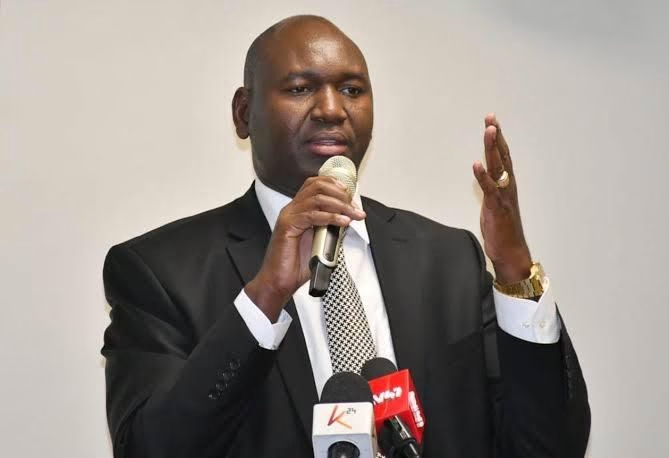
Chairman of the Kenya National Examination Council (Knec), Julius Nyabundi, stated yesterday that the Mathematics taught at primary and junior levels is sufficient to develop understanding in the subject. It was also revealed that academic performance in Mathematics in secondary schools has historically been poor when compared to primary school exit examinations.
Andrew Otieno, Knec’s deputy director for Quality Assurance and Archives, noted that an analysis of KCPE and KCSE examinations indicates that students demonstrate commendable Mathematics performance when leaving primary school, but a significant drop is observed when they take their Form Four exams.

For instance, an examination review from 2022 shows that more than 80 percent of candidates achieved grades between A and D+ at the Class Eight level; however, this percentage fell to 17. 46 percent in the KCSE results.
The poor results positioned students’ final examinations in secondary schools in Uganda, Tanzania, and Zambia ahead of Kenyan candidates. Nonetheless, Otieno explained that this isn’t due to a challenging curriculum but rather the stringent grading and assessment system.
“This emphasizes the necessity to reevaluate core subjects in senior secondary school, ensuring that Mathematics is only undertaken by students whose courses require it,” he stated.
He made these comments yesterday during the inauguration of the second Knec Annual Symposium on Competency Based Assessment in Nairobi.
In a conversation on the sidelines of the symposium, Nyabundi asserted that learners will have acquired the necessary arithmetic literacy by the conclusion of junior secondary school, thus defeating the purpose of mandating it in senior secondary school.
“Competency-Based Curriculum is formulated to enhance foundational skills by the end of junior secondary school (Grade 9),” he remarked.
Nyabundi suggested shifting focus to subjects that align with learners’ strengths, such as the humanities or vocational skills, which could enhance overall academic and learning performance.
This announcement follows public outcry after the Ministry of Education disclosed that Mathematics would be an optional subject at advanced levels. Instead, English, Kiswahili or Kenya Sign Language, Community Service Learning, and Physical Education would be the required subjects.
However, it is also anticipated that as many as 60 percent of students in senior secondary school will choose to take Mathematics as they will follow the science, technology, engineering, and mathematics (STEM) route.
Otieno contended that making Mathematics compulsory puts learners on the arts pathway at a disadvantage.
Knec stated that this amendment could potentially solve the “dismal pass rate below 30 percent” in KCSE Mathematics.
He also indicated that numerous national examination boards across the region adhere to a similar trend.
Simultaneously, the requirement for Community Service Learning and Physical Education as mandatory subjects has been supported.
Eunice Gachoka from the Kenya Institute of Curriculum Development asserted that research has demonstrated that Physical Education contributes to the development of a well-rounded student.
“Whether it pertains to psychomotor skills, coordination, or cognitive growth, Physical Education has been shown to contribute to the overall development of a student, which is why it is deemed a mandatory subject,” she stated.
Community Service Learning, she mentioned, would cultivate a patriotic and responsible citizenry. This comes as various speakers delved into the decline of social values and patriotism among Kenyans.