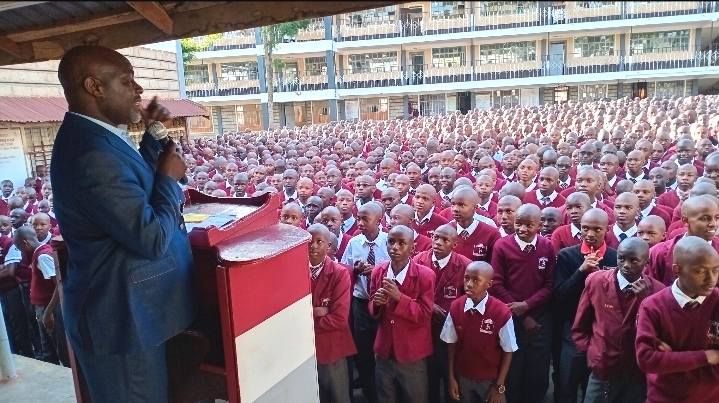
Here’s a comprehensive, detailed profile of Meru School (Kenya) covering its history, background, location, academics (including 2025 performance), national status & CBE pathways, leadership & staff, facilities, and co-curricular activities:
—
1. History & Background
Meru School was established in 1956 by early Kenyan educators as a boys’ secondary institution linked with Meru Teachers College. The first classes were taught under trees near Mwithumwiru Primary School with an initial small cohort of students drawn from Meru and neighboring regions.
In 1958 it briefly became co-educational by admitting six girls, but by 1961 girls were moved to Kaaga Girls High School and Meru School reverted to being a boys’ school.
With the introduction of the 8-4-4 education system in 1985, the school began presenting students for the Kenya Certificate of Secondary Education (KCSE) examinations from 1989 onwards.
Over decades, Meru School has expanded from small beginnings into one of Kenya’s leading national boys’ boarding schools, known for producing strong academic performers and holistic graduates.
—
2. Profile / Background / Location
Name: Meru School
Type: Public National Boys’ Boarding Secondary School
County: Meru County, Eastern Kenya
Sub-County: Imenti North
Address: Along Meru-Maua Road, P.O. Box 1903, Meru, Kenya
KNEC Code: 15300002
The school’s motto is “In Understanding Be Men”, reflecting its focus on character development as well as academic excellence.
Meru School has a substantial student body (over 1,200 learners) and a staff complement that includes qualified teachers and support personnel engaged in both teaching and pastoral duties.
—
3. Academic Performance / Success
KCSE 2025 Performance
Mean Score: Close to 10.0 (approx. 9.97), one of the highest in recent years for the school.
Total Candidates: ~545 candidates sat the exam.
University Transition: An exceptionally high percentage of students qualified for university entry.
This performance affirms Meru School’s continued relevance as an academic leader among national schools.
KCSE 2024 Performance
In 2024, the school presented 489 candidates in KCSE, registering a mean score of ~9.366 (an improvement from 2023), with more than 93% qualifying for university admission under government sponsorship.
Grade distribution included:
52 students with A (plain)
83 with A-
110 with B+
100 with B
77 with B-
35 with C+
The strong consistency in performance over the years demonstrates the school’s academic resilience and culture of excellence.
—
4. National Status & CBC / CBE Pathways
National School Status
Meru School is categorized as a National School under the Ministry of Education — a classification awarded to institutions with historically strong academic performance, excellent management, and broad geographic student recruitment.
Under Kenya’s national school cluster system, it has been placed in Cluster One (C1), which covers the top tier of secondary schools with more resources and higher academic performance expectations.
CBC / CBE Learning Pathways
The school is transitioning toward Kenya’s Competency-Based Education (CBE) system (which replaces the 8-4-4 system). It will offer structured Senior School CBE pathways starting as the first Grade 10 cohort joins in 2026.
These tracks are designed to help students develop competencies relevant to future careers, creativity, critical thinking, and problem-solving skills.
—
5. Leadership / Principal & Staff
Principal / Head of School
The school leadership has included Mr. Lawrence Kariuki Kiwara (Principal) in recent years, credited with academic guidance and leadership.
School leaders over time have emphasized hard work, discipline, teacher commitment, and moral grounding as critical drivers of academic success and student performance.
Academic & Support Staff
Meru School has qualified teachers employed through the Teachers Service Commission (TSC), supported by non-teaching staff handling administration, boarding coordination, and student services.
Teachers participate in continuous mentorship, remedial support, and academic enrichment programs, contributing to strong KCSE outcomes.
—
6. School Facilities
Meru School offers a range of infrastructure and facilities that support academic, residential, and co-curricular development:
Academic Facilities
Classrooms for all forms
Science laboratories for Physics, Chemistry & Biology
Computer / ICT labs supporting digital learning and research
Library resources for study and reference
Boarding & Welfare
Dormitories / boarding houses for students
Dining hall/cafeteria
Guidance and counseling spaces
Recreation & Sports
Sports fields and courts for games and PE
Space for athletics and other competitive activities
Support Resources
Internet access/network resources (e.g., high-speed Faiba internet connection) to enhance learning and research activities.
These facilities help foster a holistic environment where boys receive academic support as well as social and physical development guidance.
—
7. Co-Curricular Performance & Activities
Meru School encourages wide participation in co-curricular activities to nurture talents beyond academics. Common engagements include:
Sports & Games
Athletics
Team sports (soccer, basketball, hockey, rugby, etc.)
The sports programs help build teamwork, discipline, and physical fitness.
Arts & Clubs
Debate & Public Speaking
Drama & Performing Arts
School clubs (science clubs, social clubs, etc.)
These clubs offer platforms for students to develop leadership, creativity, and communication skills.
Leadership & Character Building
Prefect systems
Community service projects
Moral education programs
Meru School’s environment emphasizes values like discipline, civic responsibility, and resilience, helping shape learners into future leaders.