Ministry of Education to increase TVET enrollment from the current 500,000 to 2 million Students

The Ministry targeting to increase TVET enrollment from the current 500,000 to 2 million Students.
Education Cabinet Secretary Julius Ogamba has reiterated the government’s dedication to enhancing investment in Technical and Vocational Education and Training (TVET) to provide millions of Kenyan youth with essential skills and knowledge.
By the end of 2025, the Ministry of Education aims to boost TVET enrollment from the current 500,000 students to two million.
While speaking in Mombasa during the transformation of the former Mama Ngina Secondary School into a TVET college, Ogamba emphasized the government’s recognition of TVET’s crucial role in tackling the country’s socio-economic issues, such as youth unemployment, skills shortages, and poverty alleviation.



“We reaffirm our commitment to ensuring that every Kenyan has access to quality technical training. We understand that for Kenya to meet its ambitious development goals under Vision 2030, we must equip our workforce with the practical skills that are in high demand in both local and global job markets,” he stated.
Ogamba noted that the government is focused on ensuring access, equity, and quality in TVET education. This will be achieved by prioritizing the construction of new institutions and expanding existing ones to ensure that every county has a modern TVET facility, bringing training closer to the communities.
The government will also continue to provide various funding options to support students from diverse socio-economic backgrounds.
“Through this initiative, more young Kenyans will be able to enroll in technical courses without the burden of financial constraints,” Ogamba added.
He also mentioned that they are implementing extensive curriculum reforms and forming industry partnerships to ensure that TVET institutions offer programs that meet the demands of industries and emerging sectors like digital technologies, renewable energy, and manufacturing.
The government is also intensifying efforts to promote TVET as a viable career option by changing the perception surrounding TVET education.
“This is a significant shift, as we want our youth to appreciate the value of practical skills and the career opportunities they offer,” he said, emphasizing the government’s goal of ensuring that all learners have access to quality training to contribute to the nation’s economic growth.
To prevent disruptions in learning, the government recently allocated Sh1.56 billion for the maintenance and tuition loan payments for 31,263 TVET students and 33,863 university students.
“In the current Financial Year 2024/2025 alone, the Higher Education Loans Board (HELB) has distributed Sh32.7 billion in upkeep and tuition loans to 195,522 TVET students and 390,612 university students,” the CS explained.
He further assured TVET and university students that the government will fully support them in completing their studies.
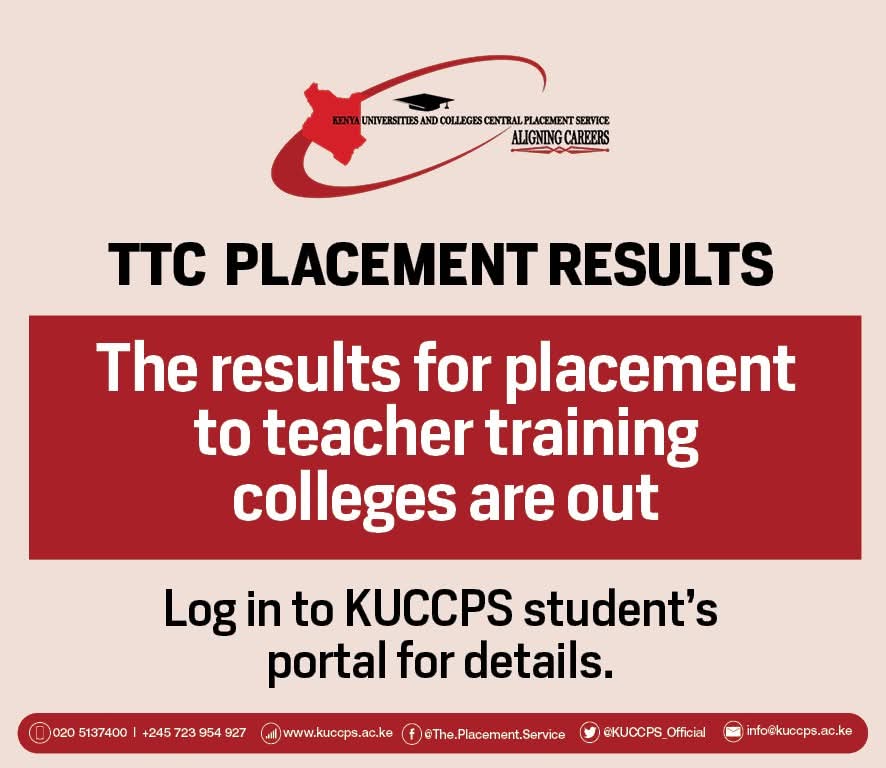
Kenya Certificate of Secondary Education Examination (KCSE) graduates were urged to apply for available opportunities to pursue various courses in TVET institutions each time the Kenya Universities and Colleges Placement Service (KUCCPS) opens its portal.
The CS directed KUCCPS to conduct another application process for eligible TVET students by June 2025 to ensure a second intake took place by September 2025 after the placement of the first cohort of applicants in the May intake.
“In the same vein, I have asked KUCCPS to open its portal this month for the KCSE 2024 candidates to apply for placement into various programmes in private and public universities in the 2025/2026 Academic Year,” he said.
He urged all the 246,391 students who attained a mean grade of C+ and above in 2024 KCSE examinations to apply for placement once the portal was opened.
Technical University of Mombasa Vice Chancellor Prof. Laila Abubakar reiterated the need for synergy between TVET institutions and industries, stating, “TVET is hands-on; there should be a symbiotic relationship between training institutions and industries to enhance practical learning.”