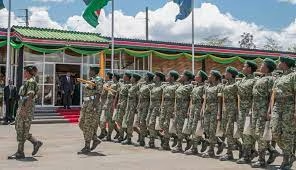
The National Youth Service (NYS) has expressed concerns that its allocation of Ksh. 11.18 billion for the 2025/26 fiscal year is inadequate for its operations.
According to the 2025 Budget Policy Statement (BPS) presented by Commandant-General James Tembur, this amount includes Ksh. 10.06 billion for recurrent expenses and Ksh. 115 million for development projects.
However, NYS, which transitioned from a state department to a semi-autonomous state corporation in 2019, estimates it needs Ksh. 26.48 billion, resulting in a shortfall of Ksh. 15.3 billion.
NYS has indicated that it will struggle to meet the expected costs associated with the increased recruitment numbers mandated by President William Ruto’s 2023 directive, which calls for an annual intake increase from 10,000 to 100,000 youths.



The President also urged NYS to achieve self-sustainability by the 2027/28 fiscal year.
“Resource requirements for the service for the financial year 2025-2026 took into consideration the presidential directive to increase the youth intake that is to be implemented in a phased approach,” stated the policy statement presented by Public Service Cabinet Secretary Justin Muturi to the National Assembly Social Protection Committee on Wednesday.
Muturi informed lawmakers that with the current allocation, NYS will be unable to recruit the planned 40,000 youths in two cohorts.
“The Service has recruited 20,000 youths in the third quarter of 2024/2025 in line with the President’s directive. It is worth noting that the budget for FY2024/2025 can only accommodate 10,000 youths,” he added.
NYS had previously requested additional funding for 10,000 more recruits, which was under consideration, and received Ksh. 1 billion for food and rations. However, the allocation for the new fiscal year has been reduced by Ksh. 500 million.
Additionally, NYS has stated that it cannot fulfill its development needs, such as infrastructure improvements necessary for accommodating and training recruits, with the current budget. Muturi noted that the lack of a development budget for the current fiscal year, which ends in June, has hindered the Service’s efforts to enhance its already strained and deteriorating facilities.
“The existing infrastructure and facilities, including barracks, dining halls, classrooms, workshops, water and sanitation systems, and security walls in all field units, are in poor condition, overstretched, and inadequate,” the CS told Parliament.