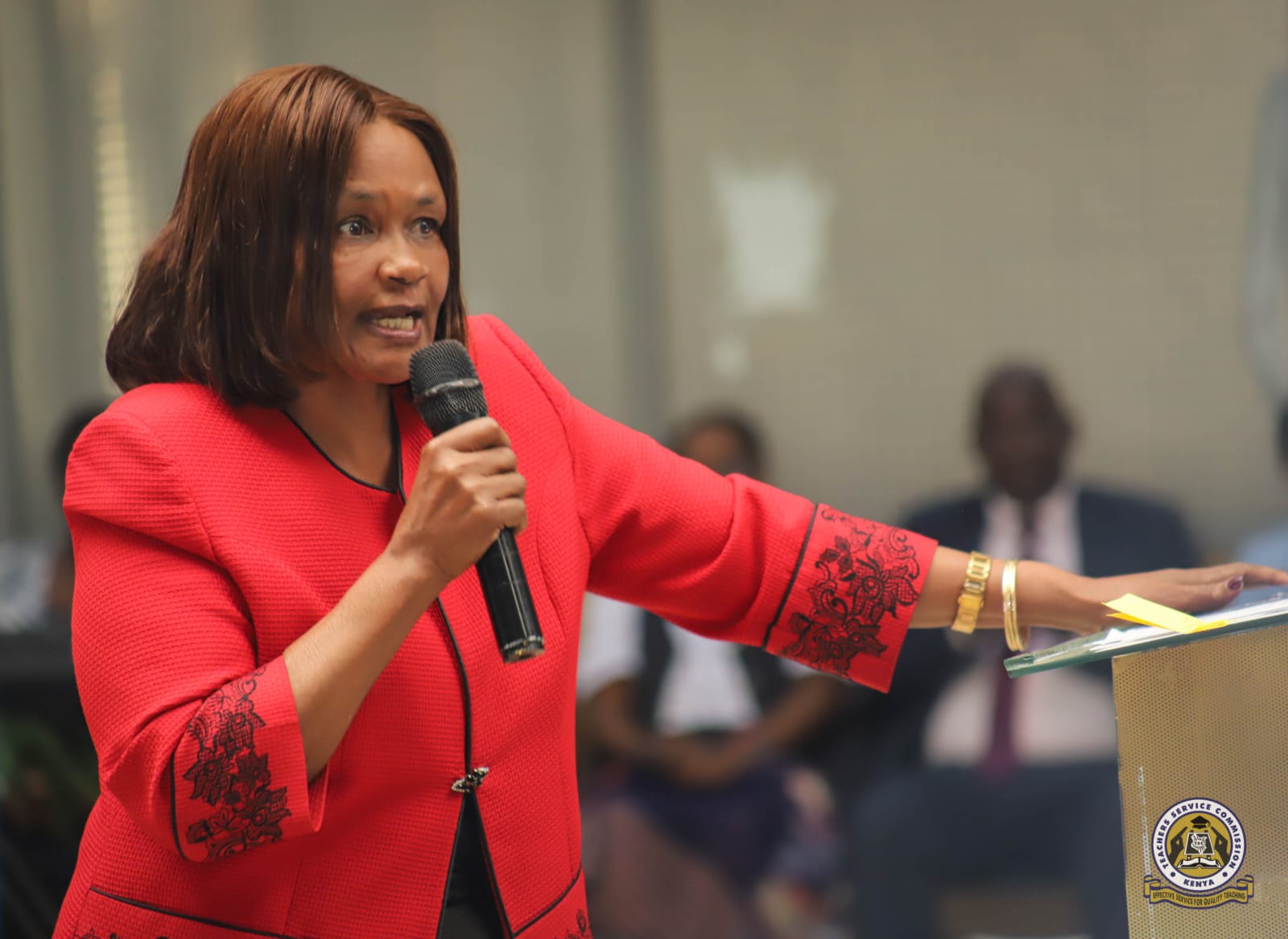
Acting TSC CEO Evelyn Mitei
Memorandum Submitted to the Teachers Service Commission
The review of the Career Progression Guidelines (CPG) provides an important opportunity to strengthen the teaching profession, improve career mobility, and recognize professional excellence among teachers. A well-structured promotion framework motivates teachers, enhances retention, and ensures that the education system benefits from experienced and highly skilled educators.
The following observations and proposals aim to address current challenges within the CPG framework and to establish a more balanced, fair, and professionally rewarding career structure for teachers.
The current framework creates nine grades for graduate teachers in secondary schools and ten grades for diploma teachers. This structure is unnecessarily complex and slows career progression.
Primary school teachers have seven grades, while secondary teachers have more. This disparity creates inconsistencies within the teaching profession.
The former Job Group K was split into two levels (C4 and C5). This change unnecessarily prolongs the time teachers spend before advancing to higher ranks.
The introduction of three deputy principal levels has complicated the administrative hierarchy, even though one of these tiers is equivalent to the role of principal.
Four tiers for senior masters or mistresses have been introduced. This creates unnecessary bureaucratic layers that do not necessarily translate into improved instructional leadership.
Diploma teachers previously progressed from Job Group J to K to L before interviewing for M. Under the current system, they move from C1 to C2 and must immediately compete for promotion, limiting fair progression.
Teachers are often required to take administrative positions in order to advance professionally. This restricts career growth for highly competent classroom teachers who prefer to remain in teaching roles.
To improve efficiency, fairness, and motivation within the profession, the following reforms are proposed:
A streamlined structure would promote clarity and faster progression. The recommended grades are:
C2
C3
C4
D1
D2
D3
D4/D5
Combine C4 and C5 into one grade.
Combine D1 and D2 into a single level.
This will remove unnecessary duplication and reduce stagnation.
These grades should remain automatic progression levels based on experience and performance rather than competitive interviews.
Teachers should spend three years in common cadre grades.
Teachers in promotional grades should qualify for the next interview after two years of service.
Enter service at C1.
Serve six months probation only.
Automatically move to C2 after probation.
Promotion to higher job groups should not depend on administrative appointments. Teachers should be able to progress professionally while remaining classroom practitioners.
Teachers who take up administrative roles such as Deputy Head of Institution or Head of Institution should receive an additional administrative allowance rather than relying solely on promotion for compensation.
To recognize excellence in teaching without forcing teachers into administration, a professional classroom-based career ladder should be established.
Entry level teacher responsible for classroom instruction and student learning.
Experienced teacher with improved instructional expertise.
Highly experienced teacher involved in mentoring younger teachers and supporting curriculum delivery.
Expert teacher recognized for outstanding pedagogy and subject mastery.
Responsible for leading subject panels and strengthening curriculum implementation within departments.
Advanced instructional leader who continues to teach while guiding academic programmes.
The highest professional rank for exemplary classroom practitioners who demonstrate outstanding educational leadership.
Teachers who wish to move into administration should follow a separate leadership pathway.
1. Deputy Principal – D1/D2/D3/D4/D5
2. Principal – D3
3. Senior Principal – D4
4. Chief Principal – D5
Administrative positions should focus on leadership and institutional management rather than serving as the only pathway for professional promotion.
The system should allow flexibility in career paths.
1. Deployment Rather Than Promotion:
Master classroom teachers may be deployed as Deputy Principals after successful interviews without losing their professional rank.
2. Optional Administrative Service:
Teachers may choose to remain professional classroom experts without entering administrative roles.
3. Opportunity to Join Administration Later:
Lead, Senior, and Chief Master Teachers should be eligible to apply for administrative deployment if they later wish to serve as Deputy Principals.
4. Right to Revert to Classroom Teaching:
Principals, Senior Principals, and Chief Principals should be allowed to return to classroom practice at equivalent professional levels if they choose to leave administration.
Implementing these proposals would bring several benefits:
1. Faster and fairer career progression for teachers.
2. Recognition of classroom excellence without forcing teachers into administration.
3. Simplified job grade structure that is easy to understand and implement.
4. Increased teacher motivation and job satisfaction.
5. Strengthened instructional leadership in schools.
6. Better retention of experienced teachers within the profession.
7. Improved quality of teaching and learning in Kenyan schools.
A balanced Career Progression Guideline must reward both instructional excellence and administrative leadership. By reducing unnecessary job grades, separating professional promotion from administrative roles, and creating a strong classroom career ladder, the Teachers Service Commission can establish a fair, motivating, and sustainable career structure for all teachers.
These proposals are respectfully submitted for consideration in the ongoing review of the Career Progression Guidelines.
Get all the Kenya Certificate of Secondary Education (KCSE) 2026 Project, Practical Exams Materials &… Read More
Kenyatta University (KU) is a public chartered university with its main campus in Kahawa, Nairobi,… Read More
Get the latest Mwalimu National Sacco BOSA Loans Application Form {Free Download}, here. PDF Latest… Read More
Here is the revised and latest Mwalimu National Sacco FOSA Salary Advance Application Form {Free… Read More
Here is the latest Mwalimu National Sacco FOSA Instant Loan Application Form {Free Download}. Download… Read More
The landscape of digital gambling has shifted toward high-octane mechanics that prioritize volatility and massive… Read More
