PS wants wants TSC functions separated to curb corruption in teacher recruitment and promotions

Geoffrey Ruku, the nominee for Public Service Cabinet Secretary, has suggested revising the Teachers Service Commission (TSC) Act to distinguish the commission’s various functions, such as teacher recruitment and promotions.
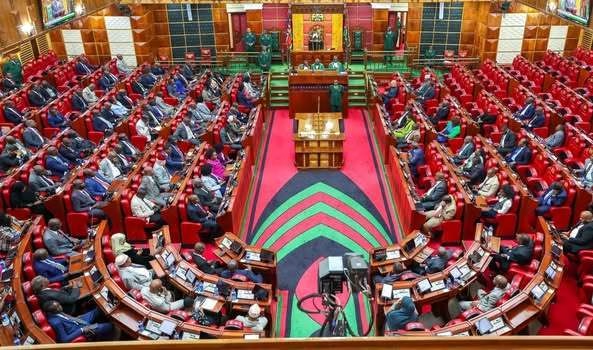
During his vetting by the National Assembly Committee of Appointments on Monday, Ruku stated that this change could help combat allegations of corruption in the education sector.
He admitted to previously discussing corruption related to teacher promotions, sharing that he knows many teachers who have faced difficulties in this area.
“I have publicly stated that there is corruption in the promotion of teachers, as I have many classmates who are teachers in both primary and secondary schools, and I am aware of their experiences with the promotion process,” Ruku explained.


He pointed out that some teachers are denied promotions based on merit due to corrupt actions by certain officials.
“Some teachers cannot advance based on their qualifications. Across our sub-counties, there are corrupt individuals within the Teachers Service Commission and at the sub-county level who solicit bribes for promotions, whether in primary or secondary schools,” he noted.
Ruku expressed his obligation, as a representative of Mbeere North Constituency, to denounce this misconduct and called on the TSC to hold its officers accountable.
“I urged the Teachers Service Commission to put an end to these practices by some of their officers at the sub-county level,” he added.
To tackle these issues, Ruku mentioned that if confirmed, he would advocate for legislative reforms.
“One suggestion is to review the Act that established the commission to determine if the TSC, being a large institution, needs multiple directorates managed independently by perhaps three executive managers instead of just one. This could apply to areas like teacher promotions, hiring, and insurance management,” he said.
When asked if he understood that the TSC is an independent Constitutional Commission and would not fall under his authority if appointed, Ruku replied, “Yes, honorable chair, I am aware. However, as the Cabinet Secretary responsible for Public Service, I believe that service delivery—whether in police, education, or judicial services—must be addressed.”
Ruku also highlighted the ongoing issue of ghost workers in the public service, which he described as a significant burden on government efficiency and resources.
“My definition of ghost workers, honorable speaker, is anybody who is employed by government offering public service, will report work and appears after 10 or so minutes. We have cases where doctors or clinic officers or even nurses report to work, and within 10 minutes, honorable speaker, are out of the dispensary, out of the hospital, to other clinics within the surroundings,” he said.
To counter this, Ruku said he would implement an integrated digital system across all government institutions.
“We put a system in place which can be able to link all the government institutions… Once you go to your place of work, we are supposed to know you have reported at what time, your output, and what time did you leave your workstation.”
He further accused public procurement officers of negligence, particularly in the management of government assets.
“We have procurement officers who have ensured government vehicles which are supposed to be disposed of are lying in parking yards for years, so government ends up losing huge amounts of money,” he said.
He pointed to Executive Order 2023, which placed the transformation of public service delivery under the Ministry of Public Service, as a key pillar in implementing the digital framework.
“Having a unified digital government framework will enable us to solve some of these challenges we are facing, as far as ghost workers are concerned. It will help us in cutting the cost and ensuring that service delivery is timely, effective, and cost-efficient,” he said.
On employment, Ruku pledged to uphold the values of equity, transparency, and fairness, as enshrined in the Constitution.
“I will serve the Republic of Kenya without fear and without favour. The issues of employment will be cut across. The face of Kenya must be seen as per our Constitution, as per Article 232.”
He emphasised that gthe overnment is not an employer by default, but a facilitator for job creation.
“Government is there to create enabling environment for job creation, especially for our young people,” he said.
He also promised to streamline public service processes, including business registration.
“At the moment, it takes about a week or so for a business to be registered. We endeavour to ensure it is registered within the same day so that we can be able to create more jobs within all the sectors of our economy,” he said.
In his financial disclosures, Ruku said his net worth stands at Sh377 million. This includes land and buildings worth Sh40 million, a family residence valued at Sh60 million, shares worth Sh250 million, vehicles worth Sh12 million, and Sh15 million in savings and Sacco deposits.