Senators investigate allegations that newly recruited Teachers benefited from the 25,000 TSC promotion vacancies

Senators investigate allegations that new recruits benefited from the promotion of 25,000 teachers.
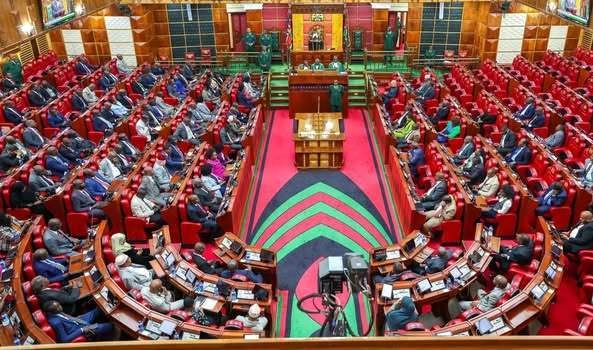
Senators have joined Members of the National Assembly in demanding inquiries into purported irregular promotions by the Teachers Service Commission (TSC), with the lawmakers characterizing the State agency as “headquarters of corruption” and advocating for a cleansing of its leadership.
The legislators are seeking an explanation from the TSC regarding the reasoning behind the distribution model utilized in the promotion of the 25,252 teachers, especially concerning counties that are heavily populated but receive a smaller number of promotions.
This situation follows considerable outrage from various sectors regarding the promotions, with MPs accusing the State agency of employing vague promotion criteria and failing to maintain principles of fairness.



MPs contended that the promotions disproportionately benefitted certain regions while excluding deserving candidates from other areas, straying from previous practices and disregarding population trends. Senators now seem to be echoing the sentiments of their colleagues in the National Assembly, advocating for investigations into the promotions.
Sounding the alarm, Kisii Senator Richard Onyonka stated that the TSC should be compelled to demonstrate whether the criteria employed for selecting teachers for promotion throughout different counties adhered to the principles of merit, fairness, and inclusivity.
Lawmakers are requesting the TSC to clarify if a grievance redress and appeal mechanism was established for the teachers who felt wronged by this promotion process, along with how many complaints the TSC has received and how many have been resolved thus far.
“The Education committee must investigate and report to this House why long-serving teachers with higher academic qualifications and graduates were overlooked while younger teachers with lesser qualifications and fewer years of experience were promoted during this process, and if so, the reasoning behind it,” said Mr. Onyonka.
The committee, led by nominated Senator Betty Montet, will also be tasked with requiring the TSC to detail the measures it is taking to foster transparency and accountability to resolve the longstanding issues of career stagnation among teachers. Nominated Senator Esther Okenyuri labeled the State agency as “the headquarters of corruption. ”
She alleged that some unscrupulous officials at TSC demand bribes from teachers who are already in a desperate situation in order for them to attain promotions.
“In the recently concluded exercise, we have teachers who have served for over 17 years but were not promoted,” remarked Ms. Okenyuri.
“Conversely, there are teachers who have just served for one year and were promoted. How can one justify that? I will reference a trade unionist named Benjamin Burombo. He said that ‘when I am fighting for African rights, the other hand is busy keeping away Africans who are fighting me,’” she continued.
The lawmaker called for a complete overhaul of the agency’s leadership, asserting that the employers of teachers are fundamentally corrupt.
“I bring up the TSC and point out that certain officers have indeed remained in their positions longer than allowed. My concern is that the underlying culture remains unchanged, implying that reshuffling them may not prove effective. That culture extends from the national level down to the grassroots,” stated the senator.
“I acknowledge that corruption will consistently retaliate, yet we will continue to confront this matter. This is due to the fact that teachers require support and fair pay to maintain their motivation in providing their services to Kenyans,” she added.
Nandi Senator Samson Cherargei supported Ms. Okenyuri’s views, agreeing that the TSC is “the epicenter of corruption and they ought to be held accountable. ”
“There was also considerable political favoritism (during the promotions). It has been reported that the TSC has delegated its recruitment duties to other entities, including politicians, and they need to be taken to task. ” Some teachers’ unions have expressed concerns regarding the promotions, asserting that some teachers with only six months of experience were elevated when the policy stipulates a minimum of three years required for eligibility.
Principals are also uncomfortable with the process, contending that the quota system employed by the TSC for promoting teachers disadvantages regions with a greater number of qualified educators.
Despite the discontent surrounding the promotions, TSC chief executive officer Nancy Macharia has asserted that the procedure adhered to legal standards and was decentralized to guarantee regional representation.