Shame as Ruto, MPs takeover TSC employments’ role
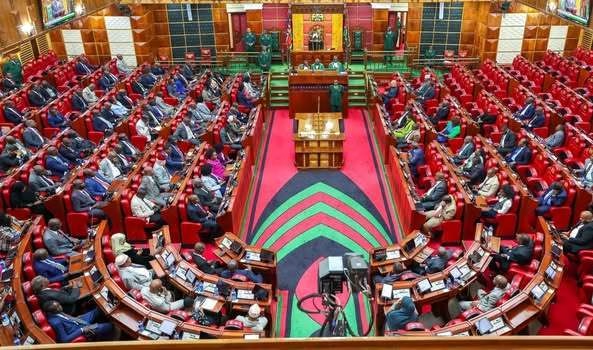
Teachers are expressing outrage after Murang’a Woman Representative Betty Njeri Maina revealed that government-aligned Members of Parliament (MPs) recently received employment letters from the Teachers Service Commission (TSC) to distribute to their constituents. This disclosure has led to widespread criticism regarding alleged improper hiring practices.
Teachers’ unions have vehemently opposed this approach, claiming it breaches legal regulations and denies qualified Kenyans job opportunities, especially at a time when the country faces high unemployment rates among trained teachers.
Ms. Maina explained that they were called to State House, where she acknowledged receiving employment letters for teachers. She was accompanied by eleven MPs from Kiambu, each receiving twenty letters, amounting to a total of 220.



She also mentioned that Mathioya MP Dr. Edwin Mugo was present from Murang’a. She pointed out that many teachers in Maragua Constituency are still awaiting job placements and expressed her intention to encourage the local MP to align with the government to ensure that development projects, including job opportunities, benefit the area.
Furthermore, she criticized MPs who did not attend the State House meeting for failing their constituents by missing the chance to secure teaching positions.
Ms. Maina’s comments inadvertently highlighted a widely recognized yet seldom acknowledged truth in political circles: public sector employment is often leveraged as a means to reward political loyalty.
In a previous incident, former Education Cabinet Secretary Ezekiel Machogu was seen personally handing an employment letter to an unemployed teacher at a public event in Kisii County, intensifying concerns about favoritism in government job assignments.
Last year, Kibwezi West MP Mwengi Mutuse—who gained national attention for initiating the impeachment motion against former Deputy President Rigathi Gachagua—proudly showcased his influence during a funeral in December. He instructed attendees to find a qualified teacher willing to work at Muatini Secondary School and submit the name before the ceremony concluded, assuring them that the chosen individual would be processed for employment by Monday and start teaching immediately.
He provocatively questioned whether anyone outside the government could facilitate such employment, underscoring the idea that political connections dictate access to public sector jobs.
This ongoing controversy raises significant concerns about transparency in public employment processes and the evident politicization of job allocations within government institutions.
Moses Nthurima, the acting Secretary-General of the Kenya Union of Post-Primary Education Teachers (Kuppet), and Hesbon Otieno, the deputy secretary-general of the Kenya National Union of Teachers (Knut), have criticized the politicization of teacher hiring, asserting that State House does not have the authority to make such appointments.
Nthurima raised concerns about the fairness of the hiring process, arguing that when Members of Parliament choose friends and family over qualified candidates, it undermines merit-based recruitment. He pointed out that graduates from 2016 are still waiting for placements and stressed that political connections should not dictate hiring decisions.
He further argued that prioritizing teachers based on political ties compromises fairness and ignores the policy of addressing the backlog of earlier graduates first.
There were also concerns about the independence of the Teachers Service Commission (TSC). Nthurima expressed worry over reports of employment forms being given to politicians, claiming this undermines the Commission’s authority and indicates political interference in education. He insisted that such actions damage the credibility of a sector that should operate professionally.
Otieno supported these views, warning that political involvement could disrupt staffing standards and lead to an uneven distribution of teachers nationwide. He emphasized that the TSC, as a professional body, must retain its independence in hiring and appointing staff.
Despite these issues, it remains unclear how employment letters ended up in the hands of politicians. Efforts to get a response from Cavin Anyuor, TSC’s director for legal, labor, and industrial relations, were unsuccessful as he did not answer calls or messages regarding the matter.
Trans Nzoia Governor George Natembeya also commented on the situation, stating that access to employment letters is not equal among leaders but is restricted to those closely associated with the government.
Natembeya noted that individuals with financial means are able to secure positions, while those without must rely on government support. He condemned this practice, arguing that it disadvantages the most vulnerable and deserving teachers.
The Kenya Kwanza government had promised in its manifesto to hire 116,000 teachers within two years of taking office. So far, 56,000 permanent teachers and 20,000 interns have been recruited.
However, concerns remain about whether political favoritism is affecting the hiring process, potentially jeopardizing the integrity of teacher recruitment in the country.