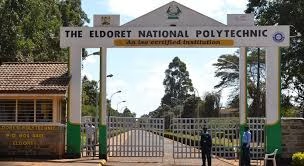
The Eldoret National Polytechnic Courses, Contacts, Fees, Location and How To Apply
The Eldoret National Polytechnic
The Eldoret National Polytechnic is located along Eldoret-Kapsabet Road, approximately 5 kilometers from Eldoret town. It was officially opened on September 25, 1990.
The polytechnic began modestly with a few courses and a small student body. It has since grown into a prominent institution known for its technical and vocational training programs. The main campus is located on Eldoret-Kapsabet Road, with a town campus situated in Eldoret town.
The institution is registered with Technical and Vocational Education and Training (TVET) Authority and is listed on the KUCCPS website. It is a government TVET institution under the Ministry of Education, State Department for Technical, Vocational Education and Training.
The Eldoret Polytechnic Contacts
o contact the Eldoret National Polytechnic, you can use the following methods: email at inquiries@tenp.ac.ke or info@tenp.ac.ke, or call +254 797 222666. You can also visit their Town Campus in Zion Mall, Eldoret Town, or their main campus located on the Eldoret-Kisumu Highway next to The Catholic University of East Africa – GABA Campus.
Here’s a more detailed breakdown:
Email:
inquiries@tenp.ac.ke
info@tenp.ac.ke
Phone:+254 797 222666
Town Campus:Zion Mall, Eldoret Town
Main Campus:Eldoret-Kisumu Highway, next to The Catholic University of East Africa – GABA Campus
Postal Address:P.O. Box 4461 – 30100, Eldoret
The Eldoret National PolytechnicApproved Diploma and Certificate Programs
Apply directly to the College for consideration in a number of Diploma and Certificate Courses offered at the TVC..
Eldoret National Polytechnic offers a wide array of courses across various departments, including Engineering, Applied Sciences, Business Studies, Health Sciences, and Hospitality & Institution Management. Some specific courses include Diploma in Electrical and Electronic Engineering, Diploma in Mechanical Engineering, Diploma in Civil Engineering, and Diploma in Business Management. Additionally, they offer courses in areas like Health Sciences, such as Diploma in Pharmacy and Diploma in Medical Laboratory Technology.
Here’s a more detailed breakdown:
Engineering:
Electrical and Electronic Engineering, Mechanical Engineering, Civil Engineering (including Building and Construction), Agriculture Engineering, and Welding and Fabrication.
Applied Sciences:
Applied Chemistry, Applied Biology, Environmental Science, Food Science, General Agriculture, and Food Technology (CBET).
Business Studies:
Business Management
Sales and Marketing
Supply Chain Management
Banking and Finance
Human Resource Management
Secretarial Studies
Health Sciences:
Diploma in Pharmacy, Diploma in Medical Laboratory Technology, Diploma in Health Records and Information Technology, Diploma in Nutrition & Dietetics, and Diploma in Medical Engineering.
Hospitality and Institution Management:
Food and Beverage Management, Catering & Accommodation Management, Tourism Management, and Fashion Design & Clothing Technology.
The Eldoret National Poly Kuccps Approved Courses
The Polytechnic offers the following Courses that are approved by the Kenya Universities and Colleges Central Placement Service (KUCCPS):
Studying at Eldoret National Polytechnic offers several advantages, including strong industry partnerships, modern facilities, and a supportive learning environment. The polytechnic’s location in Eldoret provides access to various industries for internships and potential job opportunities. Additionally, the institution has a strong relationship with the local community, contributing to a supportive and harmonious learning atmosphere.
Here’s a more detailed look at why you might choose Eldoret National Polytechnic:
Industry Connections:
The polytechnic has established strong partnerships with companies like Mumias, Nzoia, and Kenya Seeds, providing students with valuable internship and job placement opportunities.
Modern Facilities:
Eldoret National Polytechnic boasts state-of-the-art facilities, including computer labs with high-speed internet and advanced workshops, enhancing the learning experience and preparing students for the demands of their chosen fields.
Community Support:
The institution’s strong relationship with the surrounding community ensures a supportive environment for students, with many able to study from home due to the rural-urban setting, thus reducing costs.
Dedicated Personnel:
Eldoret National Polytechnic is known for its dedicated and highly qualified teaching and non-teaching staff, contributing to a harmonious and cooperative learning environment.
Practical Training:
The institution emphasizes practical learning experiences through field trips, research projects, and community engagement, allowing students to apply their knowledge in real-world contexts.
Flexible Learning:
The polytechnic offers flexible learning schedules, including evening and weekend classes, making it accessible to a wider range of students.
Accessibility:
The institution’s main campus is conveniently located along the Eldoret-Kapsabet road, and it also has a campus in Eldoret town, making it easily accessible by both public and private transport.
Strong Academic Programs:
The polytechnic offers a wide range of academic programs designed to equip students with the skills and knowledge needed for success in their chosen fields.
Focus on Entrepreneurship:
Cross-cutting units like Entrepreneurship and IT are integrated into the curriculum, preparing graduates for the world of work in various sectors.
The Eldoret National Polytechnic Fees Structure
The Eldoret National Polytechnic has a total annual fee of Ksh 56,420 for most programs. This includes tuition, registration, maintenance, medical, attachment, sports, and other levies. A government capitation of Ksh 30,000 is provided for KUCCPS students, reducing the payable amount.
Here’s a breakdown of the fees:
Tuition Fees:Ksh 34,120
Class Practical:Ksh 4,000
Medical Fees:Ksh 2,000
Attachment Fees:Ksh 1,100
Sports Fees:Ksh 4,000
Internet Levy:Ksh 800
Library Levy:Ksh 800
Personal Emolument:Ksh 6,000
Local Travel and Transport:Ksh 800
Electricity, Water, and Conservation:Ksh 800
Student Union:Ksh 1,200
Maintenance:Ksh 800
Total:Ksh 56,420
Note: Some courses might have additional fees for KNEC practicals.
FEES STRUCTURE FOR ONE ACADEMIC YEAR
VOTE AMOUNT
Class practical Ksh.4,000.00
Tuition fees Ksh.34,120.00
Registration fees Ksh.0.00
Maintenance Ksh.800.00
Medical fees Ksh.2,000.00
Attachment fees Ksh.1,100.00
Sports Ksh. 4,000.00
Internet levy Ksh.800.00
Library_Levy Ksh.800.00
Personal emolument Ksh.6,000.00
Local Travel and Transport Ksh.800.00
Electricity Water and Conservation Ksh.800.00
Caution Money Account Ksh.0.00
Student Union Ksh.1,200.00
TOTAL Ksh.56,420.00
NOTE 1. When you come to register you must pay the FULL AMOUNT of fees as you cannot be registered on the polytechnic computer system until you have paid. Fees is Payable through either BANKERS CHEQUE, MPESA paybill No.304250 or Eldoret National Polytechnic, National Bank of Kenya-Eldoret Branch-01021027668101
NOTE 2: All new students to pay Ksh.500 caution money and Ksh.500 registration fee.
The following courses will also be required to pay KNEC practical fees; Diploma in Catering and Accomodation
(KSh.6,000),Diploma in Food and Beverage Management (KSh.6,000) and Certificate in Catering and Accomodation
(KSh.6,000),.Certificate in Food and Beverage Management to pay Ksh.3,000
NOTE 3: GOVERNMENT CAPITATION The total fee payable per year is Ksh.56, 420.The government will pay
sh.30,000 for each KUCCPS student. The balance of Ksh.26,420 shall be paid directly by the parent to the institution or may be raised by applying for a loan from Higher Education Loans Board (HELB).
NOTE 4: When you come to register present your letter of offer to the registry, who will check your certificates and direct you to the cash office to pay the fee payable, caution money and registration fee.
This amount does not include Exams Fees. The amount payable for KNEC can be obtained from the respective departments and must be paid before the deadline for KNEC registration. An affiliation fee charged by professional bodies is also paid separately.
The fees payable above does not include Hostel Accommodation which is very limited and may not be available. Please enquire from the Dean of students if you require hostel facilities.
NOTE 5: Students applying directly through the institution are required to pay ksh.750/= non refundable
The Eldoret National Polytechnic Fees Structure.
The Eldoret National Poly Courses Duration.
The Polytechnic courses vary in duration, depending on the specific course. Generally, Craft Certificates take 1-2 years, while Diplomas can range from 2-3 years. Some short courses, like welding or baking, may be completed in a few weeks or months.
Examples of course durations:
Craft Certificate:
Building Technology: 1 year 6 months (Module I & II)
Carpentry & Joinery: 2 years
Plumbing: 3 months
Welding & Fabrication: 8 weeks
Diploma:
Building Construction Technology: 3 years
Human Resource Management: 3 years
General Agriculture: 3 years
Automotive Engineering: 3 years
Short Courses:
Welding/Fabrication: 12 weeks
MIG Welding: 8 weeks
TIG Welding: 8 weeks
Cake Baking and Decoration: 2 months
Factors affecting course duration:
Level of the course:Certificates are typically shorter than Diplomas.
Specific trade or field:Different trades may have varying durations.
College or institution:Some institutions may have slightly different program structures.
Intake schedule:Some courses have specific intake periods (e.g., January, May, September).
The Eldoret National Polytechnic online application
Applications and placement to the Polytechnic are done through the Kenya Universities and Colleges Central Placement Service (KUCCPS) Portal. To apply for placement through KUCCPS, you need to access the student’s portal on the KUCCPS website and log in using your KCSE index number, year of examination, and password. Once logged in, you can explore available programs and institutions, and then submit your preferred choices. Start your application by clicking on this Kuccps Student Portal Link.
You can also apply directly to the institution for admission.
The Minimum requirements are: C- for diplomas, D+ for craft certificates and E for artisan courses. But, different Courses may have more specific requirements.
The Eldoret National Polytechnic college admission requirements
To qualify for any course at Nyakach Technical Training Institute, you must first meet the requirements below;
Be a Kenyan citizen and have either an Identification card or a birth certificate to prove this.
You must have completed your KSCE and received your certificate.
Have scored the required minimum grade as per the programme you are applying for.
You need a mean grade of:
C– (minus) and above for diploma courses.
D (plain) and above for craft certificate courses
D – (minus) and below for artisan certificate courses
The Eldoret National Poly Kuccps application procedure
After confirming that you qualify for a course at the Technical Training Institute, the second step is to apply to the National Polytechnic. There are two ways to apply to Vocational and Training Institute; physically collect the application letter from the institution’s admission office. Apply through the Kenya Universities and Colleges Central Placement Service (KUCCPS). As this is an online application, you must carefully follow the instructions given to ensure a successful application. The process is as given below;
Click on the apply now tab and choose your preferred programme.
Once a course is successfully selected, the website automatically redirects you to the student portal for KUCCPS.
Click on the log-in prompt. You will be prompted to enter your KCSE index number, year of completion, and password as previously selected.
On a successful log-in, click on institutions. Scroll through the list of available TVET colleges and select the National Polytechnic.
The screen displays the college and all the courses on offer for that academic year.
Click on the course you want to apply. A 7-character code appears; note this down.
Click on the revision tab. Click on Apply now; it prompts you to enter the 7-character code you noted down. Enter the code and submit your application
Finally, make the necessary application payments through your mode of choice from the provided list; preferably MPESA.
In the KUCCPS online application, a successful submission must have the programme code, name/duration, and the institution’s name. If successfully considered, you will receive an admission letter via the portal that you download and use to get admission to the institution. Of course, you will also receive your admission results via SMS.
The Eldoret National Polytechnic Admission Letter.
You can get the admission letter to the Polytechnic by visiting the Kuccps Student Portal, Instituion’s Website and by paying a physical visit to the Tertiary institution. But, the best, quickest and most convenient application method is via the Kuccps portal.
All National Polytechnic Diploma, Certificate and Artisan Courses Fees
Download the free pdf documents below that have complete details of all TTI Courses and their Fees per year:
Career Opportunities for National Polutechnic Graduates
Polytechnic graduates in Kenya have a wide range of career opportunities, primarily in technical and vocational fields. These include roles as trainers in TVET institutions, skilled workers in various industries like construction, manufacturing, and hospitality, and entrepreneurs who can leverage their skills to start their own businesses.
The Career opportunities for Technical and Vocational Training Colleges’ Graduates include:
1. TVET Trainer/Lecturer:
Many TVET institutions are actively seeking qualified trainers to teach in various disciplines.
Opportunities exist at both the certificate and diploma levels, requiring specific qualifications and often pedagogy training.
Examples include positions at institutions like the Kenya School of TVET, The Eldoret National Polytechnic, and various other TVC institutions.
2. Skilled Trades and Technical Roles:
Graduates can find employment in various industries that require technical skills, such as:
Construction:Building, plumbing, electrical installation, etc.
Manufacturing:Machine operation, fabrication, maintenance, etc.
Hospitality:Food and beverage service, catering, housekeeping, etc.
Agriculture:Agri-business, farm management, animal health, etc.
ICT:Hardware and software support, networking, web development, etc.
The demand for skilled workers in these sectors is constantly growing.
3. Entrepreneurship:
TVC graduates can use their skills to start their own businesses. Examples include:
Fashion and design:Tailoring, dressmaking, fashion design.
Cosmetology:Hairdressing, beauty therapy, nail art.
Automotive:Mechanics, panel beating, auto electrical work.
The government encourages entrepreneurship through various initiatives and support programs.
4. Other Job Opportunities:
Public Relations and Receptionist:
TVETA, for example, has advertised for positions like Public Relations Assistant/Receptionist.
Career Counseling and Guidance:
Graduates with relevant experience can work in career guidance and counseling roles in institutions or with organizations like the Office of Career Services (OCS).
Project Management:
Some TVET institutions are also offering programs in project planning and management, which can lead to roles in project coordination and implementation.
5. Specific Fields in Demand:
The following fields are highly on demand and are worthy considering:
Digital Skills:
The rise of technology has increased demand for professionals in digital design, smart construction, and other related fields.
Creative Industries:
Skills in areas like journalism, interior design, fashion design, and media production are also in demand.
Sustainable Practices:
The growing focus on green and sustainable building practices opens up opportunities for professionals in these areas.
6. Government Initiatives:
The Ministry of Education, State Department for TVET actively seeks to recruit qualified trainers and other staff.
Various government agencies and institutions offer internship and training programs to support TVET graduates.
GOVERNMENT SCHOLARSHIP AND LOAN FOR POLYTECHNIC STUDENTS.
Following your placement, you are eligible for a Government scholarship, Loan and Bursary to assist with your educational expenses. If you need Government financial support, you MUST make an application for consideration through the official website www.hef.co.ke. In the case Government scholarship, Loan and bursary do not cover the entire cost of your program, the deficit will be met by your parent/guardian.
REQUIREMENTS FOR APPLICATION FOR NATIONAL POLYTECHNIC STUDENTS’ FUNDING
1. A valid email address
2. Valid telephone number (must be registered in your name to apply for a loan)
3. KCPE and KCSE index numbers and year of examination
4. Passport size photo
5. Copy of your National ID (for loan application)
6. College/University admission letter
7. Your parents’ registered telephone number
8. Your parents’ national ID number
9. Death certificate if any of your parents is deceased.
10. Your birth certificate.
11. Two guarantors’ (Can be your parents) ID numbers and registered telephone
The Education News Hub Editorial Team is made up of vibrant and experienced editors. Brian Yano is an accomplished longtime Digital Media Journalist at Educationnewshub.co.ke with a great passion for research and fact-checking. He delivers engaging content across diverse topics, with a special interest in Education matters. On her part, Yvonne Kemunto is a journalist, dedicated to unraveling stories that matter. With a keen eye for detail and a passion for storytelling, she brings a fresh perspective to the world of media. Her commitment to detail and excellence shines through in every piece she crafts. Our newest member of the Editorial Team is Jennifer Mumbo. She is a Seasoned Multimedia Journalist with several years' experience; dating back to 2018. Jennifer has a passion for education, sports, tech, politics and entertainment. You can reach the editors at educationnewshub3@gmail.com.