The Teachers Service Commission (TSC) has sent out the first set of promotion letters for teachers across various counties, enabling the placement of 23,388 promoted teachers in schools starting next week. TSC County and Sub County Directors will manage the assignment of these teachers to schools with open positions.
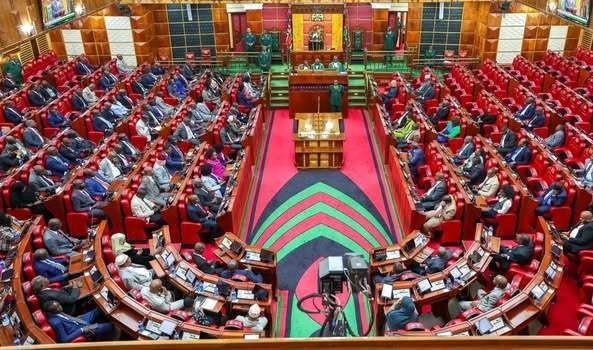
This action follows the approval from the National Assembly Committee on Education, led by Tinderet MP Julius Melly, to promote this number of teachers. However, this figure falls short of the 25,252 teachers the TSC had aimed to promote after interviews conducted in January and February.
The decision comes after the National Assembly allocated Sh1 billion for promotions, which only covered 5,690 of the 25,252 vacancies. Concerns were raised by MPs regarding the promotion of 5,291 teachers who were deemed ineligible due to not meeting the minimum three-year requirement outlined in the Career Progression Guidelines (CPG). The TSC faced accusations of bias and discrimination in the promotion process, with claims that some teachers were promoted prematurely and that there were disparities in promotion opportunities across different counties.
In a report to the Education Committee on May 27, TSC revealed that 1,864 teachers had been removed from the initial promotion list published in April due to not fulfilling the three-year requirement. TSC CEO Nancy Macharia stated that these removals were made in accordance with the Committee’s recommendations, and the resulting vacancies would be redistributed fairly based on the number of interviewed candidates.


The TSC is also developing new promotion guidelines to establish clear criteria and procedures for promotions, aiming for a fair and transparent process. This comes in light of the recent promotion of 5,291 teachers who had not met the three-year service requirement, which was sometimes waived to address historical staffing issues and underrepresentation in marginalized areas.
Macharia explained that an analysis before the promotion vacancies were advertised showed a lack of qualified applicants in certain counties. For example, for the Grade D3 (Principal) position, there were not enough teachers in Grade D2 who had served the required three years, leading to a nationwide reduction of the experience requirement to six months. Similarly, the requirement was waived for the Deputy Principal III (D1) position in 18 counties, including Migori, Narok, Busia, and Mandera.
In response to the MPs’ criticisms regarding bias in the process, the TSC was given a week to submit a detailed report. Macharia also announced plans to automate the promotion process through an online system, which would facilitate digital applications, shortlisting, feedback, and the issuance of promotion letters, thereby enhancing transparency and reducing human error.
The Commission has introduced a standardized interview scoring system that takes into account performance appraisals, leadership experience, age, and academic contributions. Furthermore, a new promotion policy allows for automatic advancement for teachers in common cadre grades, provided they meet the three-year service requirement and maintain satisfactory performance.
The TSC is also committed to ensuring progressive promotions in Arid and Semi-Arid Lands (ASALs), where many teachers serve in lower grades while handling administrative duties without proper recognition or allowances. The goal is to align these teachers’ grades with their responsibilities through affirmative action initiatives.