The Teacher Service Commission (TSC) has come under fire from legislators and education advocates due to discrepancies between counties in its recently published list of 25,252 teachers who have successfully obtained promotions.
With 690 promotions, Machakos County was at the top of the list, while Garissa, the county with the fewest promotions, had just 303.
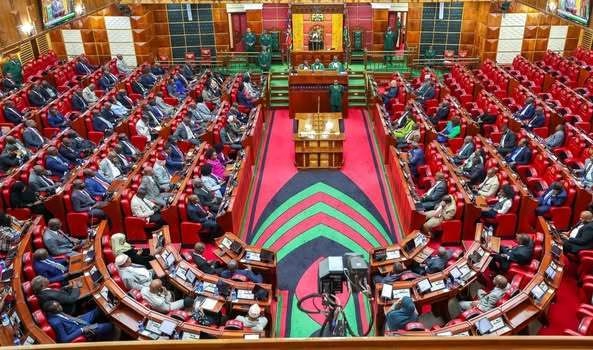
Lawmakers’ requests to examine the promotions prompted the National Assembly Committee on Education to receive the data.
The figures, however, have sparked controversy, with queries regarding the criteria used to select which teachers were promoted and how the positions were allocated nationwide.
Led by Tinderet MP Julius Melly, lawmakers strongly condemned the apparent consistency in promotion distributions, arguing that it disregards demographic realities and deviates from historical norms.




Melly, the head of the education committee, criticized the Commission for advancing some instructors numerous times while allowing others to remain in the same job category for more than ten years.
He inquired, “How do you promote someone three times in a row while others have been stuck in one job group for more than a decade?”
“We have gotten similar complaints from instructors before. This list was compiled without any regard for fairness. We need to comprehend the TSC’s decision-making process.
The National Assembly Committee on Education then denied the list and requested a detailed justification from the TSC regarding its promotion standards. The commission has until Thursday to address the committee’s issues.
TSC Chief Executive Officer Nancy Macharia stood by the commission’s strategy in front of the MPs, asserting that the promotions were based on regulatory frameworks that guarantee consistency and fairness.
She referenced the applicable regulations, such as Regulation 73 of the Code of Regulations for Teachers, the Career Progression Guidelines, and the Policy on the Selection and Appointment of Institutional Administrators.
“Aligning promotion policies with legal and regulatory frameworks, the process strictly adheres to Regulation 73 of the Code of Regulations for Teachers, the Career Progression Guidelines and the Policy on Selection and Appointment of Institutional Administrators,” Macharia stated.
The Kenya Union of Post-Primary Education Teachers (Kuppet) has condemned the procedure, stating that the promotions unjustly favor areas with fewer teachers at the expense of heavily populated ones, despite her defense.
The distribution, according to Moses Nthurima, Kuppet’s Acting Secretary-General, disregarded the density of teachers and persistent issues of stagnation.
He stated that some recently hired teachers were promoted in rapid succession and that many instructors who had served in acting roles for many years were overlooked.
“Certain areas have been disadvantaged. Nthurima stated, “If the 25,000 slots were not allocated proportionately, according to the number of teachers per county, it means counties with high teacher populations are suffering. Those who have remained in a job group for years have been left out.”
The TSC reports that 5,291 teachers were elevated through affirmative action for the fiscal year 2024–25. Isiolo, Lamu, and Mandera counties, which received 282, 280, and 270 promotions, respectively, were included in the affirmative action initiative.
At the opposite end of the spectrum, Kiambu had just 46 promotions, while Nairobi and Murang’a both had 63.
The promotions spanned job categories from C2 to D5. C4 had the most promotions with 8,508, followed by C5 with 5,425 and C3 with 4,971.
Other grades included D1 with 2,519 promotions, C2 with 1,445, and D3 with 1,410. At the higher levels, D2 had 799 promotions, D4 had 128, and only 47 teachers were promoted to D5.
Nthurima asserted that the procedure was unfair and that factors such as experience, performance, and tenure were not consistently taken into account.
“Although the commission now claims it took age into account, age has never been a major consideration. Years of service, duties carried out, and performance in curricular and co-curricular activities are the main factors, he added.
He asked why teachers who had worked in temporary roles for extended periods were consistently ignored.
“Others in less populated counties are being promoted, while some instructors have acted as deputies or principals for six or seven years and are still being left to do so,” Nthurima stated.
The unionist also criticized the Commission for its lack of consultation, pointing out that Kuppet had not been involved in the promotion’s planning or execution.
“We want to know what led to such promotions.” Many deserving instructors have been overlooked, barring any undisclosed motivations. We contacted the commission, but it has yet to reply. It is as though the commission does not interact with unions. “TSC believes unions are irrelevant,” he stated.
Union leaders and lawmakers are calling for a more consultative, accountable, and reflective approach to future promotion exercises that take into account career stagnation issues and population trends in different areas.