
Why SHA declined to enroll over 360,000 teachers for health coverage – TSC CEO reveals
It has now been disclosed that the Social Health Authority (SHA) chose not to enroll over 360,000 teachers due to an absence of nationwide infrastructure.
As per Teachers Service Commission (TSC) CEO Nancy Macharia, their attempts to include teachers in SHA were unsuccessful after learning that the insurer did not have adequate structures throughout the country to support the teachers.
Addressing the National Assembly Education Committee, Macharia informed MPs that the Commission has always desired to enroll teachers in a public insurance scheme, but this has not been achievable to date.
“Last year, when we encountered problems with Minet, we aimed to transition our teachers to SHA. We have consistently sought to have our teachers under the national insurer, even during the NHIF era,” she stated.
“We convened a meeting with SHA prior to extending our contract with Minet for this final year, and they advised us that they lacked sufficient structures. They mentioned needing Ksh. 37 billion to enroll our teachers, but even then, they were not prepared to accept them this year,” she explained to the committee.
This meeting was called in response to numerous grievances from teachers nationwide, who continue to endure a lack of medical care, despite the Ksh. 20 billion contract that TSC finalized with Minet for providing medical insurance for educators.
Committee Chairperson Julius Melly recounted a distressing incident involving a teacher who was placed in solitary confinement for three months due to an unpaid hospital bill — despite having insurance coverage.
“What sort of insurance coverage is this? It’s a mess; it lacks coherence. You have an insurer, a lead consortium, an administrator, a capitator — it’s a very peculiar type of insurance. You need to move on from this arrangement,” remarked Melly.
Luanda MP Dick Maungu suggested that teachers be organized into clusters based on job group or region to expedite the approval process at health facilities, contending that the current centralized system is ineffective.
“With Bliss Health Care serving as the master capitator and considering the vast number of teachers, it becomes challenging for them to manage approvals promptly — and that’s where the delays originate. Why can’t we cluster teachers to streamline the process? Presently, the system is overwhelmed,” Maungu commented.
Macharia, however, pointed out insufficient funding as a significant obstacle to offering comprehensive medical insurance, and urged the committee to increase resource allocation.
“If our teachers are to receive the best medical services, they must be fully insured. Yet we are unable to achieve this due to budgetary limitations. We also require timely funding disbursements to the consortium, as we often face delays,” she stated.
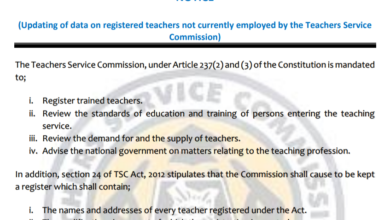 TSC Circular on Updating of data on registered teachers not currently employed by the Teachers Service Commission
 Mwalimu National Sacco Loans & Repayment Schedule (BOSA Loans)
 Latest TPAD Teacher’s Checklist of TSC Professional Documents
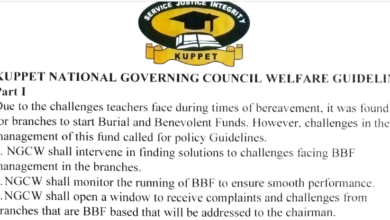 Official Kuppet BBF Guidelines For All Branches