Why SHA refused to enroll over 360,000 teachers for health coverage – TSC CEO reveals
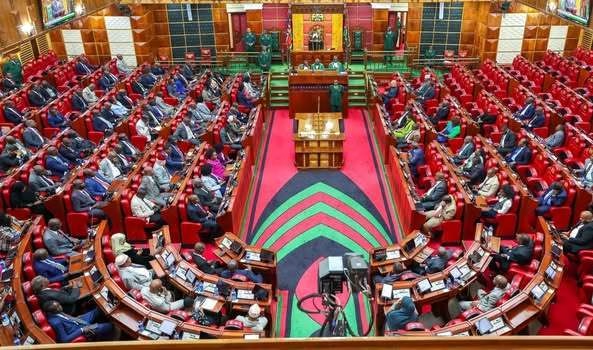
The Social Health Authority (SHA) has opted not to enroll over 360,000 teachers in health coverage due to insufficient infrastructure nationwide.
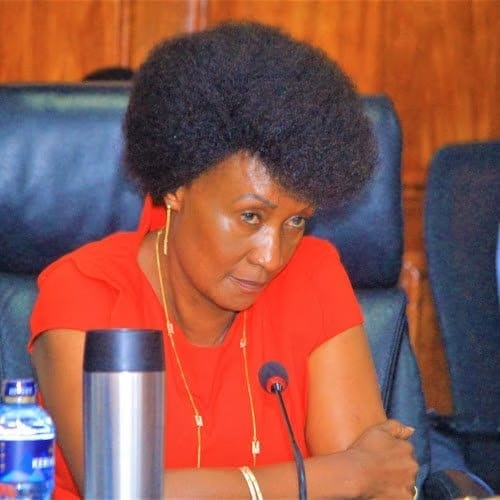
Nancy Macharia, the CEO of the Teachers Service Commission (TSC), explained that attempts to integrate teachers into SHA were unsuccessful because the insurer lacks the necessary structures to support them across the country.
During her testimony before the National Assembly Education Committee, Macharia expressed the TSC’s ongoing desire to include teachers in a public insurance scheme, which has not yet been realized.
She noted, “Last year, when we faced challenges with Minet, we aimed to transition our teachers to SHA. We have consistently wanted our teachers to be under the national insurer, even during the NHIF period.”




She recounted a meeting held with SHA prior to renewing the contract with Minet for the final year, where SHA indicated they would require Ksh.37 billion to enroll the teachers but were still unprepared to take them on this year.
This discussion was prompted by numerous complaints from teachers nationwide who are struggling to access medical care, despite the Ksh.20 billion contract that TSC has with Minet for educators’ health insurance.
Committee Chairperson Julius Melly highlighted a concerning incident involving a teacher who was isolated for three months due to unpaid hospital bills, despite having insurance.
“What kind of insurance is this? It’s a mess; it lacks coherence. You have an insurer, a lead consortium, an administrator, a capitator — it’s a very unusual type of insurance. We need to move away from this,” Melly stated.
Luanda MP Dick Maungu suggested that teachers be organized into clusters by job group or region to expedite the approval process at health facilities, arguing that the current centralized system is ineffective.
“With Bliss Health Care as the main capitator and considering the large number of teachers, it becomes challenging for them to manage approvals promptly, leading to delays. Why can’t we cluster teachers to streamline the process? The system is currently overwhelmed,” Maungu commented.
Macharia, however, pointed to insufficient funding as a significant obstacle to providing comprehensive medical insurance and urged the committee to allocate additional resources.
“For our teachers to receive the best medical services, they need to be fully insured. Unfortunately, we cannot achieve this due to budget constraints. We also require timely funding to the consortium, as delays often occur,” she explained.