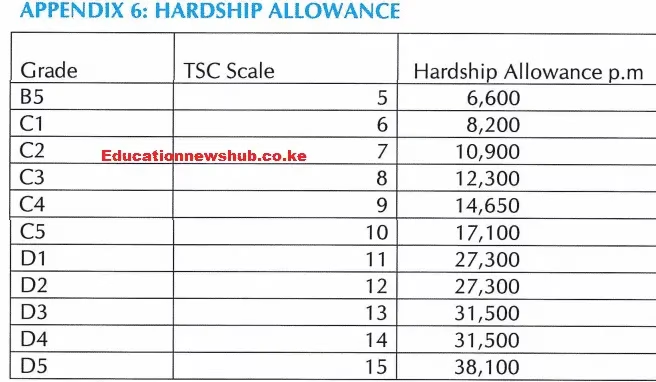
Teachers and civil servants are set to face a significant reduction in their hardship allowances, amounting to Sh6 billion, following a comprehensive reassessment of what constitutes hardship areas.
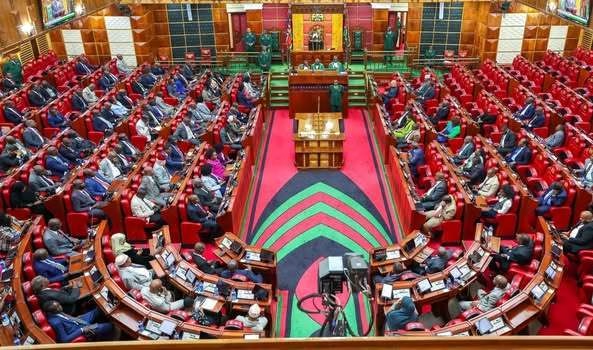
Prime Cabinet Secretary Musalia Mudavadi addressed the National Assembly, highlighting the discrepancies in how these regions are categorized. He explained, “The criteria for identifying hardship zones are inconsistent. For example, the civil service relies on outdated district boundaries, while the Teachers Service Commission (TSC) employs educational zones for their classifications.”
As a result of this long-awaited review, which has been in the pipeline since 2019, the government will slash hardship allowances for many educators and public servants. Mudavadi revealed that the adjustments will trim the annual expenditure on these allowances from Sh25 billion to Sh19 billion, yielding a substantial saving of Sh6 billion.
The review process involved extensive consultations and revealed that some areas previously designated as hardship zones have evolved significantly since the 2013 transition to a devolved governance structure. These regions have seen improvements in social and economic conditions, including enhanced access to essential services like water, healthcare, transportation, and education.

The findings from this review have been forwarded to the Salaries and Remuneration Commission, which will establish new allowance rates. Additionally, the updated list has been sent to the Chief of Staff and Head of Public Service to initiate the gazettement process.
The report also highlighted inconsistencies in the distribution of hardship allowances among public servants. Some individuals in hardship-designated areas have been excluded due to vague policy guidelines, leading to a situation where only select regions within a county qualify for the allowance, leaving others overlooked.
Mudavadi emphasized the need for a unified approach, noting that the current classifications differ across various public sectors. The civil service recognizes 16 hardship areas, the TSC identifies 44, and the Judiciary lists 21, resulting in confusion and grievances among affected parties.
This issue has not gone unnoticed in Parliament, where MPs have voiced concerns over the perceived inequities in the existing classifications.
Nyando MP Jared Okelo asked a question on the issue last month, prompting calls for a proper review to reflect current realities.
Hardship allowances were introduced in 1969 to support officers working in remote and underdeveloped areas. These are regions that lack basic services like food, water, transport, communication, and health.
Mudavadi said the aim is to apply one clear policy across all arms of the public service, so the allowance can be shared fairly based on clear and current standards.
“The proposed harmonisation of the designated hardship areas in the public service” will guide this process, he said.
The move is expected to affect workers who have long relied on the hardship allowance, as some may lose the benefit once the revised regions are made public.