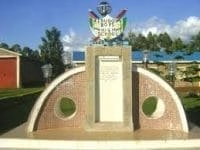
Kerugoya Boys High School details
Kerugoya Boys High School is an extra county Secondary School which stands on a fifty acre piece of land, located along Kerugoya-Kutus road approximately one kilometer from Kerugoya town in Kirinyaga County, Central region of Kenya. Kerugoya High is a top and best performing school in Kenya. This article provides complete information about this school. Get to know the school’s physical location, directions, contacts, history, Form one selection criteria and analysis of its performance in the Kenya Certificate of Secondary Education, KCSE, exams. Get to see a beautiful collation of images from the school’s scenery; including structures, signage, students, teachers and many more.
For all details about other schools in Kenya, please visit the link below;
Kerugoya Boys High School is an extra county Secondary School which stands on a fifty acre piece of land, located along Kerugoya-Kutus road approximately one kilometer from Kerugoya town in Kirinyaga County, Central Region of Kenya.
The background of Kerugoya Boys High School can be traced from the end of 1958 towards the close of the British rule in Kenya and the beginning of 1959 when the emergency period in the country ended. The current school location was initially ‘Ndia Boma Loyalist Centre” constructed in 1954 to cater for the ‘loyalists’ children in Kirinyaga County. When the Mau Mau uprisings ended and the negotiations for independence began in 1957/58 the use for this centre was no more.
Around this time, there was a greatdemand for secondary and higher education for the Africans throughout the country. This made the local African people to pressure the government to allow them to start a boy’s secondary school at Ndia Boma Loyalist Centre to make use of its existing buildings. However even being allowed, they lacked the funds and the personnel to run and maintain the school. All this time until 1960, The Boma farm had been used as a training institution, for carpentry, agriculture and masonry. The young men boarded in this centre sleeping in temporary huts built of mud walls and thatched roofs. One stone block for carpentry training was built by the boys themselves as part of practical masonry. Various crops were grown by the boys in this centre, as they learnt practical agriculture.
In I960, the Bomacentre ceased to operate and its buildings were given over to the Consolata Fathers under Fr. Cistero by the Embu county council. Bishop Carlo Maria Cavallera of Nyeri Diocese sent a Brother Brunno to start more constructions on the Boma farm site, in preparation for the start of the school. Brother Brunno built a temporary dormitory, dining room and kitchen with iron-sheet walls and roof and a cemented floor. The same Brother also built one permanent teachers’ house. In December I960 Father Tarcisius Rossi, a Cape Town South Africa B.A. graduate and an experienced education administrator joined in the preparation for the start of the school. Before joining the school, Father Rossi had served as a principal of Kamwenja Teachers’ college, in Nyeri for some time, and later as a super-visor for the C.C.M. schools in Nyeri.
The permanent carpentry building left behind by the Boma Farm, was renovated with plaster and a ceiling while the floor was cemented. The building was divided into two large rooms on both ends with three smaller rooms in between. The two large rooms would be used as a classroom and the other room as the staffroom. An indoor flush toilet was installed in the rooms in between and converted to become Fr. T. Rossi’s living house. Later the toilet was removed and the building to become a library. In January, 1961, the school began as a private boarding school for boys with thirty students, run by C.C.M, Fr. Rossi becoming its first headmaster.
The Consolata Fathers hoped to run this school as an example of a well-run institution in the country and they planned it to be wholly managed by the priests. The headmaster would also be the school’s chaplain. A large priests’ house was constructed to house about 6-9 priests who would also be teachers in the school. Government policy after independence, however, did not favour the school to remain private and the priests were therefore later to be replaced by an African headmaster In 1962, the school became government aided and in 1965 a second boarding stream was established after an impressive academic performance in the then 1964 Cambridge form four examinations. The first Board of Governors under the chairmanship of the late Hon.NjagiKibugawas constituted and officially installed in 1967.
Before this time the school was managed by Bishop Ceasar M. Gatimu. Fr Rossi left the school in 1968 and Fr. Giordano took over as the headmaster.By the early 1970’ several African teachers had joined the staff of Kerugoya Boys, they included Mr. Muiri who had started the school together with Fr. Rossi, Mr. S.N Ndungu, Mr. Anjili, Mr. Arthur Murimi, Mr. G. Wambugu and Mr. Ephraim Muriithi ( currently a member of the board )to mention a few.TheConsolata Fathers handed over leadership to the first African headmaster Mr. Francis Muiri, in January 1973, at the time the school was ranked the best in the county, in the same year Mr. Lazaro Mugo took over as chairman of the board.
A third stream was added in 1976 after the school rose to be among the best top ten in the country in the 1974 and 1975 E.A.C.E. exams registering a pass rate of 76% and 100% respectively. Due to public demand, the school was given an extra form 3 class of 40 students from harambee schools doing well in K.J.S.E and in 1978 a form one harambee class was introduced. This slightly declined the E.A.C.E performance, but the school results was still considered excellent as the school ranked 20th together with Thika High School in the country. In May, 1978, the A-level class was introduced due to excellent performance in the O-level examinations. In 1979 the school got the second African Principal from Karumandi secondary school,Mr. Tarcisius Ngariand in the same year it became four streamed.
FOR A COMPLETE GUIDE TO ALL SCHOOLS IN KENYA CLICK ON THE LINK BELOW;
Here are links to the most important news portals:
To be the powerhouse of exemplary academic achievement and character development.
To provide and sustain an enabling environment for holistic quality education for the studentsto realize their potential.
We lead the Way
In need of more information about the school? Worry not. Use any of the contacts below for inquiries and/ or clarifications:
Being a public school, form one admissions are done by the Ministry of Education. Vacancies are available on competitive basis. Those seeking admissions can though directly contact the school or pay a visit for further guidelines.
The school has maintained a good run in performance at the Kenya National Examinations Council, KNEC, exams. In the 2019 Kenya Certificate of Secondary Education, KCSE, exams the school featured in the list of top 200 schools nationally. This is after recording a mean score of 7 (C+ plus).
Also read;
For all details about other schools in Kenya, please visit the link below;
Planning to pay the school a visit? Below are some of the lovely scenes you will experience.
Also read:
SPONSORED LINKS; YOUR GUIDE TO HIGHER EDUCATION
For a complete guide to all universities and Colleges in the country (including their courses, requirements, contacts, portals, fees, admission lists and letters) visit the following, sponsored link:
Get the latest Mwalimu National Sacco BOSA Loans Application Form {Free Download}, here. PDF Latest…
Here is the revised and latest Mwalimu National Sacco FOSA Salary Advance Application Form {Free…
Here is the latest Mwalimu National Sacco FOSA Instant Loan Application Form {Free Download}. Download…
The landscape of digital gambling has shifted toward high-octane mechanics that prioritize volatility and massive…
The Teachers Service Commission (TSC) has advertised 170 job vacancies across, covering senior, mid‑level, and…
Health Cabinet Secretary Aden Duale has ordered immediate changes to the Social Health Authority (SHA)…



